

Labor pressure in mattress manufacturing isn’t new. But the current environment—marked by rising input costs, wage pressure, and tighter margins—has changed the equation.
Across U.S. manufacturing, job openings have consistently outpaced hires in recent years, according to the U.S. Bureau of Labor Statistics. Even when positions are filled, rising wages and turnover continue to increase the cost of labor-intensive processes. Together, those pressures are forcing manufacturers to find ways to maintain, or increase, output without scaling labor at the same rate.
At the same time, automation has become more practical. More flexible systems now allow manufacturers to target specific stages of production, improving output and consistency without overhauling entire operations.
Precision Where It Pays Off
Cutting and material handling are among the most common entry points.
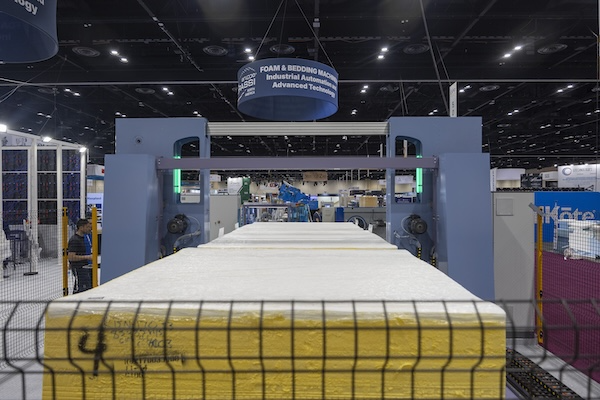
Computer-controlled cutting systems allow manufacturers to process foam and fabric with greater precision and repeatability, reducing waste and minimizing downstream errors. In an environment where material costs remain elevated, even incremental improvements in yield can translate into meaningful savings.
In many cases, these investments allow manufacturers to increase output per worker, improving throughput without adding labor at the same pace.
Supporting, Not Replacing, Labor
Assembly and sewing operations are another area of focus. But here, the approach can often be more measured.
Rather than fully replacing labor, many manufacturers are implementing semi-automated systems that improve repeatability and reduce physical strain while keeping experienced workers involved in the process. This hybrid model allows companies to increase throughput while maintaining the flexibility needed for product variation and customization.
Adoption remains uneven, particularly among small and mid-sized manufacturers, where automation is often applied selectively rather than across entire production lines. In fact, “only 8.3 percent of U.S. manufacturing firms have incorporated robots,” according to data from the National Science Foundation cited by the Information Technology and Innovation Foundation. That reality reinforces a more incremental approach, with investments focused on areas that deliver clear operational value.
Consistency in the Comfort Layer
Foam processing continues to be a key area for targeted automation. From cutting and shaping to adhesive application, automation helps reduce variability in comfort layers. As products become more complex, maintaining consistency across units becomes more difficult to manage manually.
Automated systems can standardize these processes, helping manufacturers reduce defects and deliver more reliable product performance at scale.
Efficiency at the Back End
Automated compression systems allow mattresses to be packed into significantly smaller volumes, enabling more units to be shipped in the same amount of space. Estimates vary, but compression and roll-packing can reduce volume by roughly 50% to 80%, depending on the product and method used.
That directly reduces transportation and storage costs, an important factor as mattresses, which are bulky and often subject to oversized shipping fees, move increasingly through e-commerce and direct-to-consumer channels.
As a result, packaging is no longer just an end-of-line function. For many manufacturers, it has become a key lever for improving distribution efficiency and managing fulfillment costs.
A Targeted Approach to Investment
What connects these areas is a shift in mindset. Manufacturers are not simply adopting automation for its own sake. They are evaluating investments based on where they can:
- Reduce material waste
- Improve consistency
- Increase throughput
- Stabilize labor-dependent processes
At the same time, automation is being weighed against flexibility. Many production steps—particularly those involving customization or design variation—still benefit from hands-on expertise.
Finding the Balance
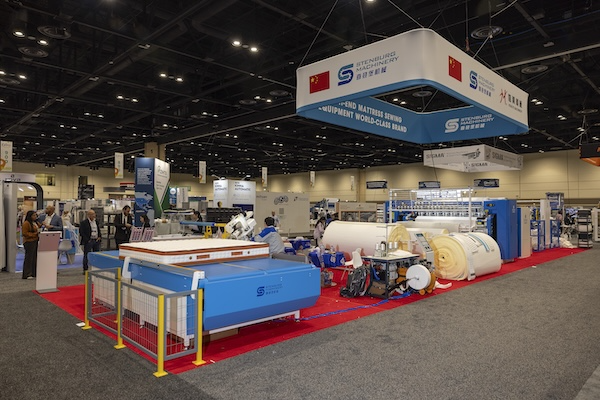
Across these areas, automation is being applied in targeted ways—focused less on sweeping transformation and more on improving efficiency where it matters most.
In the current environment, manufacturers are under increasing pressure to produce more with fewer resources—whether that’s labor, materials, or time. The result is a more measured approach to automation, with investments aimed at increasing output, improving consistency, and controlling costs without disrupting operations that already work.
As those pressures continue, both the pace of adoption and how effectively automation is applied will shape how mattress manufacturing evolves.