

In Hartford, the mattresses were piling up. Literally.
When Connecticut became the first state to enact mattress recycling legislation, it did so to solve a very real problem in the tiny state—large, bulky mattresses were consuming its few remaining landfills and costing municipalities millions of dollars for disposal.
The Connecticut bill would become a model that nearby Rhode Island—another small state with a big mattress problem—would lean on. Even California and Oregon, with much larger square mileages and different sets of issues, would use the bill as their starting point.
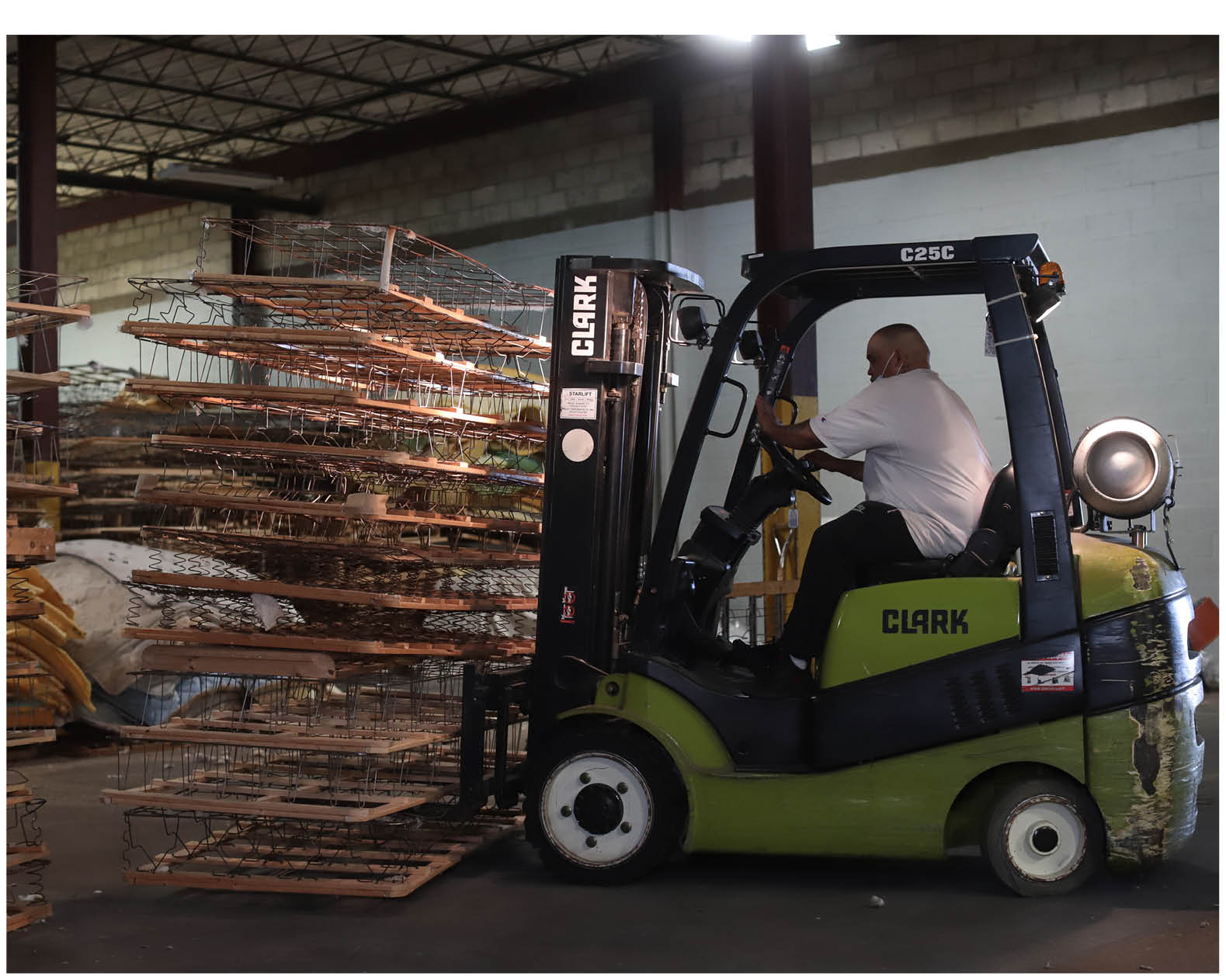
Today, with four more states considering mattress recycling legislation this year alone, the tiny model bill that could is getting a revamp: The International Sleep Products Association (ISPA) and the Mattress Recycling Council (MRC), along with the Product Stewardship Institute (PSI) and other stakeholders, are working on a new extended producer responsibility for mattresses model that could be workable across multiple states—states with differing geographies, varied population densities, unique challenges such as increased disposal costs, or other issues.
“This is the first time we’ve sat down to do this,” says Justine Fallon, vice president, operations, at MRC. “When Alison Keane (president of ISPA and MRC) started her tenure, she wanted to bring everybody to the table and talk about the barriers, how to overcome those barriers, and to explain to all the stakeholders that there are key details that are important to run a successful [mattress recycling] program and why those details matter.
“We’re not finished with the process yet. We’re still in it, but that’s the intent, to have a starting point of vetted concepts.”
Challenges at the state level
The issues and challenges surrounding mattress recycling are many.
Most states agree that mattresses take up too much room in landfills. That’s one important reason that recycling is necessary. MRC has helped save 16.8 million cubic yards of landfill space over the last 10 years by recycling more than 17 million mattresses—that’s 650 million pounds of recycled materials.
To put that in terms that people can visualize, imagine one football field covered from end zone to end zone by mattresses. The amount of landfill space saved by MRC’s mattress recycling initiatives would be equivalent to 7,876 football fields.

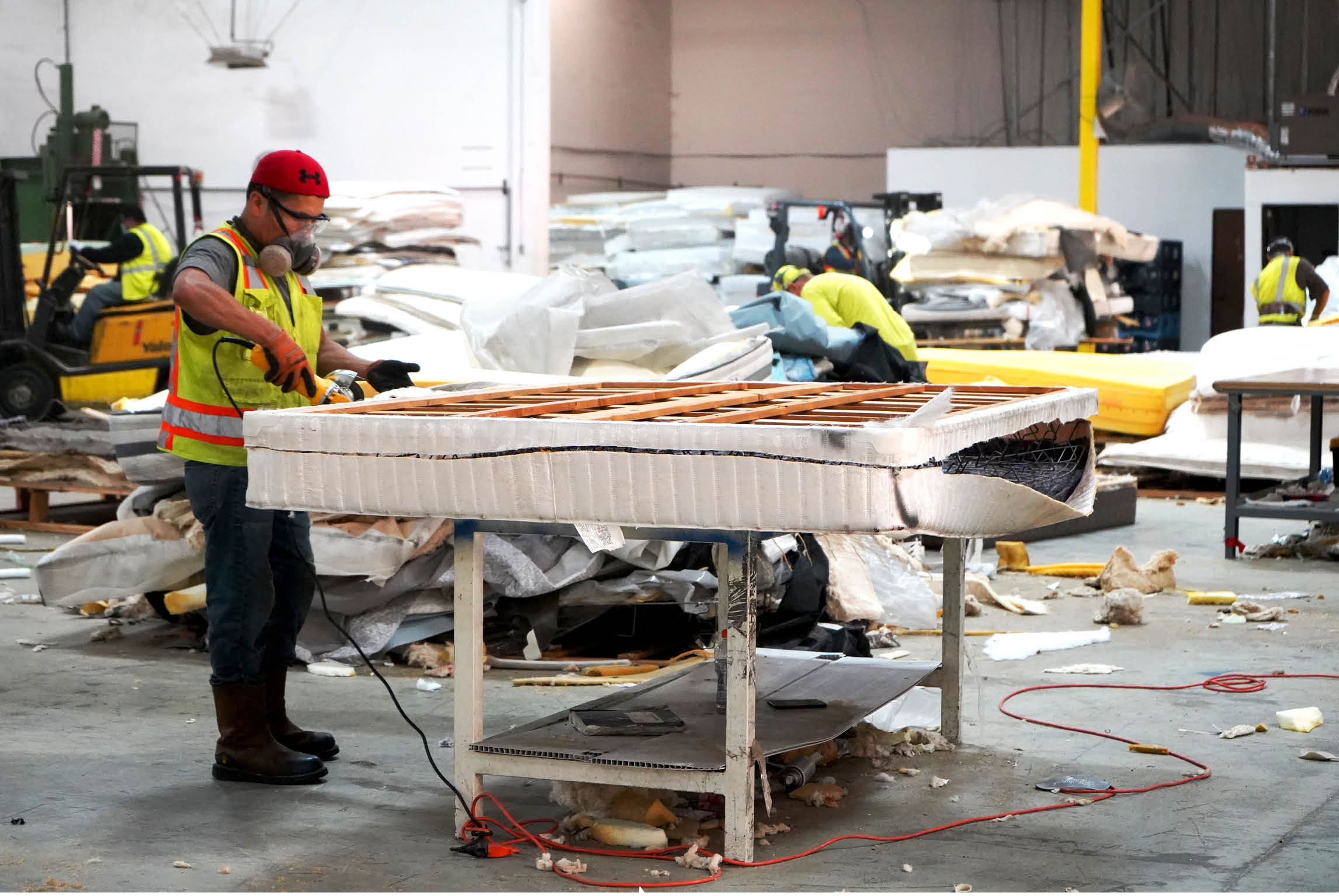
Some states have more specific issues, such as high disposal costs related to high management fees (up to $100 or more for a single mattress) or lack of convenient options for reuse, refurbishment, recycling, or disposal. Fees can be high because mattresses, with their metal pocket springs and foams, are labor-intensive to dismantle and separate. In addition, while curbside service is ideal, it’s also expensive, particularly for rural states and those with rugged terrains. Even in small Connecticut, when the city of Hartford was considering a curbside collection program, the city’s Department of Public Works was facing an additional $400,000 in annual costs, just to dispose of mattresses.
This is not to say that states and organizations haven’t been looking at these issues. Retailers, for example, have worked for years with third-party organizations to take back old mattresses when consumers purchase a new model—but again at costs that might cause consumers to balk. On the West Coast, a St. Vincent de Paul organization in Eugene, Oregon, created a program in which individuals with barriers to employment are trained to recycle mattresses, not only helping to solve the state’s mattress problem but also building a pipeline for jobs and a fresh start. And many local transfer stations found a fix by “filleting” tossed mattresses to extract the metal for recycling and make the rest easier to dispose of. But these are just workarounds.
Mattress recycling in practice
MRC was created during the passage of the Connecticut EPR law to manage the state’s mattress recycling program, with oversight from the Connecticut Department of Energy & Environmental Protection.

As it stands now, mattress legislation varies across the four states that have passed it. While Connecticut’s and Rhode Island’s laws are similar, California’s bill includes more detailed goals and added language around illegal dumping. Oregon’s incorporates best practices learned through EPR program implementation, many of which have been incorporated into the California program through amendments or administrative and plan updates.
After stakeholders like ISPA advocate for legislation and states pass it, MRC steps in to implement the requirements outlined in the law. Its first step is to identify the collection network that will recycle mattresses. Then, it helps set up collection sites, whether those are a convenient location where consumers bring a used mattress or curbside collectors that can deliver mattresses to a transfer station or recycler within the network. And that’s only the consumer-facing side: For large-volume generators such as retailers, hotels, universities, and military bases, MRC works directly with them to facilitate pickup and delivery to an in-network recycler.
MRC also manages the Bye Bye Mattress website that provides easy links to information on how people in states with mattress legislation can recycle their used mattresses, from drop-off locations to curbside pickup to retailer take-back. Then, upstream, MRC has conversations with manufacturers on EPR and source reduction—namely, how to make mattress products and components more durable and more sustainable and how to better design for recycling.
Many of those conversations take place during ISPA and MRC’s annual Sustainability Conference, where manufacturers and recyclers can learn from each other regarding products released in the marketplace and the recyclability and ease of deconstruction of various components (for more, see page 22). In California, those conversations go even deeper with MRC’s Sleep Product Sustainability Program, or SP2, which helps companies reduce negative environmental impacts, establish best practices, and define metrics. It also provides a facility certification and lays the groundwork for future certifications such as ISO 140001.
Model legislation
Connecticut passed its mattress recycling law in 2013, soon followed by Rhode Island and California. Oregon’s law passed in 2025.
This year, Virginia, New York, Massachusetts, New Jersey, and Maryland all actively discussed or have bills in progress, and many other states are watching what is happening as they carry on conversations about what to do when mattresses reach the end of life.
With interest in mattress recycling at an all-time high, PSI, ISPA, MRC, manufacturers, suppliers, recyclers, and representatives from about a dozen states have come together for productive discussions, building on current mattress EPR laws to develop a new model law that could help ease the lengthy process of passing important legislation.
“We’re really looking at it more comprehensively,” says Scott Cassel, founder and CEO of PSI. “Instead of going state by state, the idea is to get a model, where there’s agreement among all the stakeholders, and the laws would be very similar. And the benefit … is that it’s less cost for the industry and there are fewer complications when the requirements are the same or very similar, state to state. So, there’s efficiencies and effectiveness that go along with the model.”
One of those requirements involves the practical question of figuring out who will pay for the recycling of a mattress and how to ensure that cost is distributed fairly. MRC has long advocated for a nominal point-of-sale—or “externalized”—fee added to the bill of sale for every mattress. This would eliminate the need to collect any type of recycling fee once it is time for the used mattress to be recycled or otherwise managed. In addition, when customers ask, “Hey, what’s this fee?”, retailers have an opportunity to share education on the importance of mattress recycling and demonstrate their business’s—and the industry’s—passion for sustainability.
And, explains MRC’s Fallon, “While consumers pay up front for the recycling infrastructure, the cost is much less than what they would likely pay at at a transfer station or landfill when mattresses reach the end of their life.”
That infrastructure has another important benefit for states like California where illegal dumping was costing local municipalities millions of dollars to deal with every year. MRC has conducted studies and data analysis that have confirmed that no-cost and conveniently located collection sites lead to a measurable decrease in illegal mattress dumping.
However, providing accessible collection sites can be a challenge that requires discussion, says Tom Metzner, environmental analyst at the Connecticut Department of Energy & Environmental Protection. Rural states, for example, need to consider sparsely populated areas and how to balance convenient collection with the high cost of sending a truck many miles just to pick up 20 mattresses. “You know, everyone’s going to be paying for the program through the purchase of a mattress,” he says. “Everyone should have some kind of convenient collection opportunity.”
When it comes to the fee, an externalized structure also removes unnecessary complexity from the process. While some entities have suggested an “internalized” fee—in which the product stewardship organization, like MRC, would have to determine market share by manufacturer and then bill the manufacturer to pay an amount based on that number—the challenge is what happens when you factor in mattresses sold in the United States by companies that are based in other countries, says Fallon. International companies may feel no obligation to pay such fees, which could lead to a “free-rider” system in which domestic manufacturers shoulder an unfair burden of cost.
Time is another barrier when it comes to building out collection and recycler networks, since participation by collection sites and recyclers is voluntary. (To help combat this, MRC will pay collectors a handling fee. In California and Oregon, MRC offers collection site improvement funding, helping collection sites pay for any additional amenities or equipment needed to collect mattresses for recycling.) “It takes time for people to come around and realize the benefits,” says Fallon. “We also need time to build out our network, to understand the geography, the logistics, how each state operates, how solid waste moves within the states, and how best to measure our performance. That flexibility is important for the program to work well.”
“Flexibility” is the key word here. As Fallon notes, across all 50 states, there are differences in size, terrain, population density, and many other factors. When statutes or even regulations are written too narrowly, that’s when legislation can become problematic.
Ideally, any statute or regulation would provide clear guidelines within which a stewardship plan can maneuver and flexibility in devising a plan that makes sense for that state, explains Amanda Nicholson, chief of operations for PSI. For example, flexibility could mean allowing for specific program goals to be defined at the plan level or program-supported curbside service only where it is necessary to meet convenience needs of a specific community.
“We submit a stewardship plan before the program starts that outlines how we envision running the program and invite feedback from the public and regulatory agency,”
adds Fallon. “Having that flexibility to work things out in the plan allows us to work effectively within each state, because states, counties, and local municipalities do things differently.”
To avoid different EPR laws state by state, PSI developed its “16 Elements of Effective EPR Legislation” (see “Starting Point” above). Refined over PSI’s past two decades of advocating for EPR laws for everything from batteries to paint to tires, the 16 elements are what PSI suggests should be common to every EPR law, although each state may choose to address them a little bit differently. PSI has developed detailed model policy language for more than 20 EPR product sectors, always seeking to do so collaboratively with multiple stakeholders, as PSI is doing now with ISPA and MRC.
The elements are also the basis for the stakeholder meetings where the model mattress legislation is being worked out. “By having these discussions and bringing all the stakeholders together and seeking commonalities around these elements, we’ll get to a program that is most alike state to state, even as state differences are also accommodated,” says Cassel. “We’re trying to get that balance between each state doing their own thing, which happens when people don’t talk to one another. Or, in our case, we are getting people to people to talk to one another—so that they share their different interests and perspectives and hopefully get on the same page.”
Good communication
That communication piece is important. Even with laws passed in four states, there are many other possible scenarios and factors that need to be considered to create next-gen model legislation.
For example, Nicholson points toward the concerns of residents who live in apartment buildings in densely populated areas where there is no curbside access. Metzner brings up collection fees and their impact on low-income consumers. “So, a mattress can cost $100 for a twin Costco, or $5,000 for a California king, but the fee is $15 on either of them,” he says. “So, it’s more of a financial burden on lower-income people, and so I’ve advocated for a more calibrated fee that’s based on purchase price.”
Meanwhile, PSI hopes to bring more national and regional retailers to the table to ensure they can provide their input. “We haven’t reached a conclusion yet,” says Nicholson. “But the important point is that everyone’s talking about it and bringing their own expertise to the table to help solve these problems jointly.”
EPR is also not one and done, even when a law is passed. Statutes and regulations include performance goals, which Cassel says also need to be carefully structured and anchored in data to develop reasonable, but aggressive, targets. He likens EPR laws to a car: “You’ve got to get it maintained every now and then. And so that’s what EPR is. Perhaps their goals are 50% on a near-term date, and 75% at a later date.”
Adds Nicholson, “It’s an ongoing dialogue. The stakeholders are working together to make this happen. The government has their role in oversight and regulation. The producers have their role in running the program. Consumers actually have to put their mattress into the program and not dump it illegally. Retailers have a role too, in providing take-back services and education. And you know, our world isn’t stagnant. Technology changes, mattresses change, distribution channels change, so the laws have to adapt.
“These are not always easy conversations, right?” she adds. “Sometimes people disagree and they are not seeing what the other side is seeing, and it can feel frustrating at times. But one of those things that PSI has done over the years is really persist, have the patience to help people talk to each other, really translating for each other, until finally, they can say, ‘Oh, now I hear you. Now I understand. And also, that brings an idea for a possible solution to my mind that I can share, and then we can move forward.’ ”
Lessons From Connecticut
When Connecticut first began looking at mattress extended producer responsibility in the 2010s, it had just completed the successful implementation of a paint EPR program, explains Tom Metzner, environmental analyst at the Connecticut Department of Energy & Environmental Protection. Several factors influenced the successful passage and enactment of its law:
- High pressure. Along with facing a possible $400,000 annual bill to dispose of mattresses, the closure of the Hartford landfill that had processed those mattresses further pushed the issue to the forefront.
- Right time, right people. Metzner says the state benefited from a public works director in the city of Hartford who was familiar with EPR and from a committed and influential bill sponsor in the state Legislature who had supported the paint EPR law.
- Not reinventing the wheel. Metzner served on the board at the Product Stewardship Institute and leaned on its resources while also mirroring the paint EPR legislation.
- Considering your audiences—but staying flexible. During the process, the state identified hospitals, hotels, universities, and prisons as entities that could benefit from bulk recycling. It found, though, that some entities instead sold mattresses on the secondary market or used the program rarely, only when doing a mass changeover of mattresses.
- Collaborating and compromising. “When we discussed this and we negotiated the bill with ISPA, there were certain things that they wanted that we didn’t and vice versa. It was a compromise, for sure,” says Metzner. “But we got a bill.”
“You know, I always tell people, it’s a good program,” adds Metzner. “We just had the 10-year anniversary last year. There are things that could happen—like if New York and Massachusetts passed an EPR bill, I think that would greatly help the economies of scale. I know a number of states have looked at mattress EPR and have proposed it. I highly recommend it. It can lead to jobs created through mattress recycling industries, and it will save municipalities money. I think our numbers projected at $3 million a year in disposal fees that they don’t have to pay, or recycling fees.”

Starting Point
The Product Stewardship Institute has written a one-pager outlining the 16 key elements of effective extended producer responsibility legislation. It includes basic definitions of what and who is covered, responsibilities for governance, and more. Importantly, it also includes:
- Funding inputs: How funding enters the EPR system
- Performance standards: Requirements and metrics used to gauge the success and progress of the EPR program
- Outreach and education requirements: Information intended for consumers, retailers, and other key stakeholders
- Enforcement and penalties for violation: Measures to ensure compliance
- Stewardship plan contents: How responsible parties will implement the EPR program
For the full one-pager, visit bit.ly/psi-16-elements-epr.