It’s been almost 20 years since the Code of Federal Regulations 1632 was updated and 1633 became law—the codes comprising the U.S. federal standard regulating the flammability of mattress sets. In that time, companies have become technical experts in CFR 1632/33 to help bedding manufacturers remain compliant and continue to raise the safety standards of the mattresses they sell.
Today, that means innovating with raw materials, leaning into multiple compliant options, and focusing on sustainability.
“As a company, we are constantly testing and researching multiple solutions to meet compliance for our customers,” says Henry McRee, senior account executive for William T. Burnett & Co. “We work very closely with mattress manufacturers as a technical partner throughout the development process. Rather than simply supplying materials, we focus on understanding the specific challenges they are trying to solve—whether that involves fire performance, comfort, durability, cost, or sustainability.”
We’re always looking for ways to deliver better value to the market and to our customers
George Booth, product manager, Springs Creative Products Group
Strong and sustainable
McRee says one of the key trends the company is seeing in fire-retardant fabrics for the mattress industry is a growing emphasis on sustainability. “While there will always be a strong focus on regulatory compliance and fire safety performance, manufacturers are placing increasing importance on materials and solutions that are circular and sustainable,” he says.
Rather than relying heavily on chemical treatments, WT Burnett prioritizes material selection and engineering approaches that achieve the required performance through fiber choice and product design. “Wherever possible, we focus on utilizing more natural and inherently sustainable fiber blends that support both performance and environmental responsibility,” McRee says.
Dennis St. Louis, chief sales officer for Jones Family of Companies, says that sustainability has always been a focus for the business and that it continues to grow in importance. This priority shows up in the company’s efforts to lower chemical inputs, increase the use of recyclable and reclaimed materials where appropriate, and continuously improve its manufacturing processes to reduce waste and energy use. “Our goal is to support both regulatory compliance and long-term environmental responsibility,” St. Louis says.
He says that retailer pressure for “clean label” mattresses is far more prevalent today and that customers actively search for natural, sustainable fibers. At Jones, the company is answering that call with an expansive offering of cotton, wool, jute, and PLA (polylactic acid), a sustainable, plant-based textile. In addition, Jones’ new organic cotton blend has been awarded OEKO-TEX® certification, a benchmark in safety for textiles.
WT Burnett is also seeing greater interest in domestically sourced raw materials, driven largely by recent disruptions and continued uncertainty in the global supply chain. When it comes to fire-retardant fabrics, as with all other aspects of a mattress’s construction, manufacturers are looking for more reliable sourcing, shorter lead times, and greater supply-chain transparency.
Competitive pricing is also important. George Booth, who’s been in the industry for 40 years and currently heads up Springs Creative Products Group’s Firegard® flame barrier business, agrees: “We’re always looking for ways to deliver better value to the market and to our customers.”
Best of the barriers
The use of a protective fire-retardant sheath, or fire barrier, to prevent flammable inner core materials from igniting quickly has long been an industry standard.
“You’ve got a great deal of combustible material in a typical mattress, and it doesn’t really matter whether that’s a specialty sleep bed that’s mostly foam, or a foam-encased inner-spring hybrid, or a traditional spring mattress,” says Booth. “The barriers that are out there are really effective at limiting the propensity for flashover—that point where everything in the room will go from the solid phase to the gas phase of matter and burst into flame. When you’ve got a flame barrier that has an inorganic skeleton encased in char-forming fiber, you are preventing further access of the flame to the combustible material inside the envelope, depending on what you are using as a sheath fiber.”
Springs Creative’s Firegard brand of core-spun flame barriers for mattresses was introduced in 1989 and remains a staple today. “Since its inception, Firegard has been used on millions of beds with not one recall,” Booth says.
St. Louis says that Jones’ recent research is reinforcing the importance of barrier technologies. Such barriers effectively reduce flame spread while limiting the use of harsh or unnecessary chemicals. “They’re built to improve efficiency and safety, but they also must not compromise mattress feel or manufacturability,” he says.
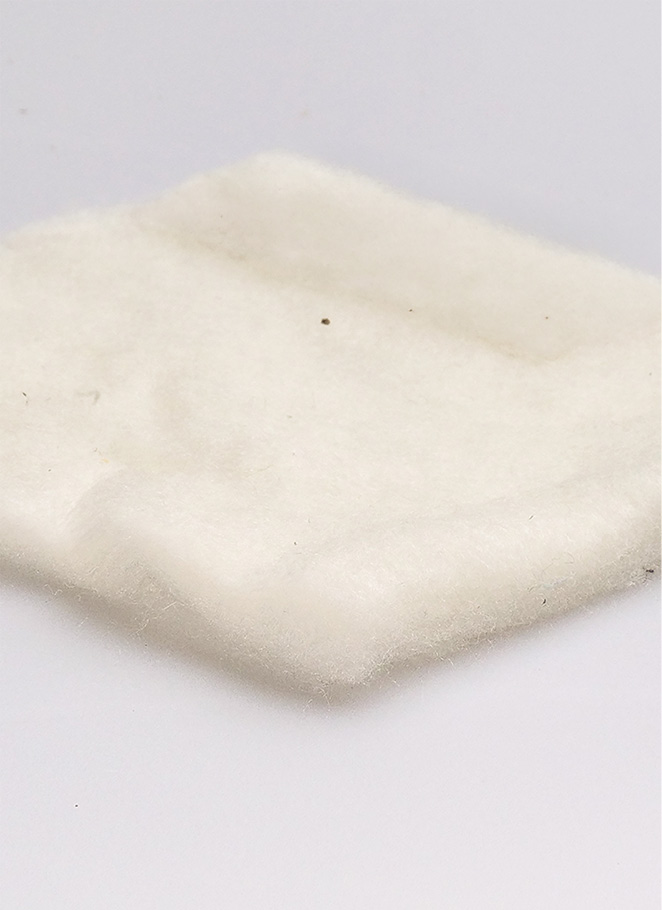
The company recently added a wool-rayon blend and an FR antimicrobial to its product portfolio. That’s in addition to its proprietary T-Bond FR barrier, which is available in a variety of fiber grades. Products like these are all about having options to comply with the standards and meet customers’ demands.
Fiberglass-free alternatives
Some state laws regulate the use of certain flame-retardant chemicals in mattresses. Most, like California, generally limit use of these chemicals in products such as mattresses, upholstered furniture, and juvenile goods (or constituent components) to a threshold of 1,000 parts per million with some exceptions.
One state, however, New York, banned use of certain chemicals altogether, with exemptions for mattress fibers expiring on Jan. 1, 2026. The International Sleep Products Association obtained enforcement discretion from New York until June so that manufacturers had more time to comply.
California also has a ban, starting Jan. 1, 2027, on textile fiberglass. ISPA worked with the state to ensure that thread or fiber used for stitching mattress components together or yarns in which the glass filaments are core-spun or sheathed by another fiber are exempt.
Nevertheless, textile manufacturers have been innovating ahead of these regulations, bringing to market fire-retardant barriers and raw materials that are fiberglass-free and even chemical-free. “We work closely with our customers early in the development process, partnering on testing, prototyping, and problem-solving,” St. Louis says. “That collaboration helps ensure FR solutions that integrate smoothly into their production lines and align with their performance, cost, and consumer expectations.”
One option is FR rayon, which Booth explained has a small amount of inorganic material in it. “That’s just enough to gum up the typical progress of self-propagating fire,” he says. “When that happens, you end up with a char layer between the sacrificial outer material and the combustible material inside the barrier.”
Passing the test
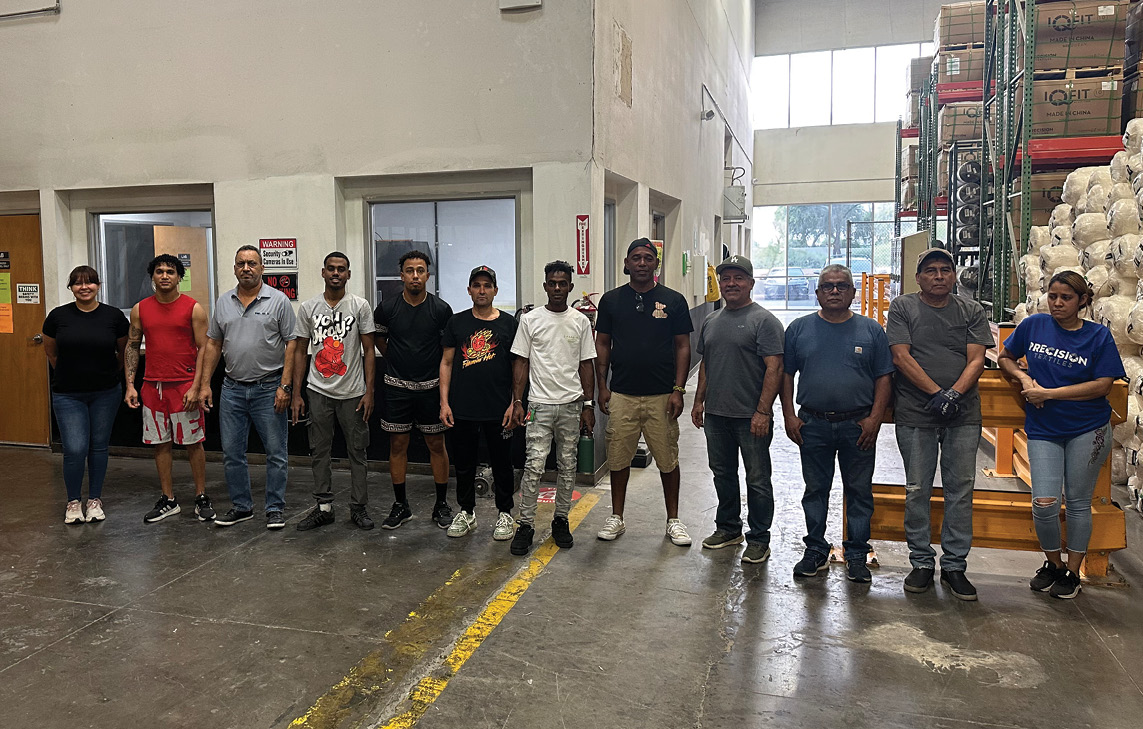
A critical part of bringing FR fabrics to market is testing them. Earlier this year, Precision Textiles spent a day of full-scale mattress burn testing at its new 60,000-square-foot manufacturing and warehouse operations in Arizona. The company—which produces both FR and non-FR high-loft solutions used in mattress panels and borders, along with Endure® FR stitchbond, IQ Fit® GlassFree socks and caps, FR-backed laminated borders, PurLoft® Organic batting, and more—evaluated multiple latex mattresses incorporating PurLoft Organic under CFR 1633 and reported consistent performance across a range of applications.
“The Arizona facility is doing exactly what we built it to do,” Keith Martin, vice president of Precision Textiles, said in a news release. “We’re seeing strong production output, high efficiency, and consistent product performance.”
Most consumers weigh comfort, design features, and cost when considering a new mattress. Safety often goes unspoken in the marketing of mattresses but is no less important. Innovations made in FR fabrics by textile companies are invaluable to the industry and to the overall safety of consumers worldwide.
“Ultimately, mattress manufacturers are seeking fire-retardant solutions that not only meet performance and compliance requirements but also align with their long-term sustainability and operational goals,” McRee says. “Overall, the most exciting part is being able to translate research and testing into practical, manufacturable solutions that our customers can use in real-world applications.”
The most exciting part is being able to translate research and testing into practical, manufacturable solutions that our customers can use in real-world applications.
Henry McRee, senior account executive, William T. Burnett & Co.