

At a Glance
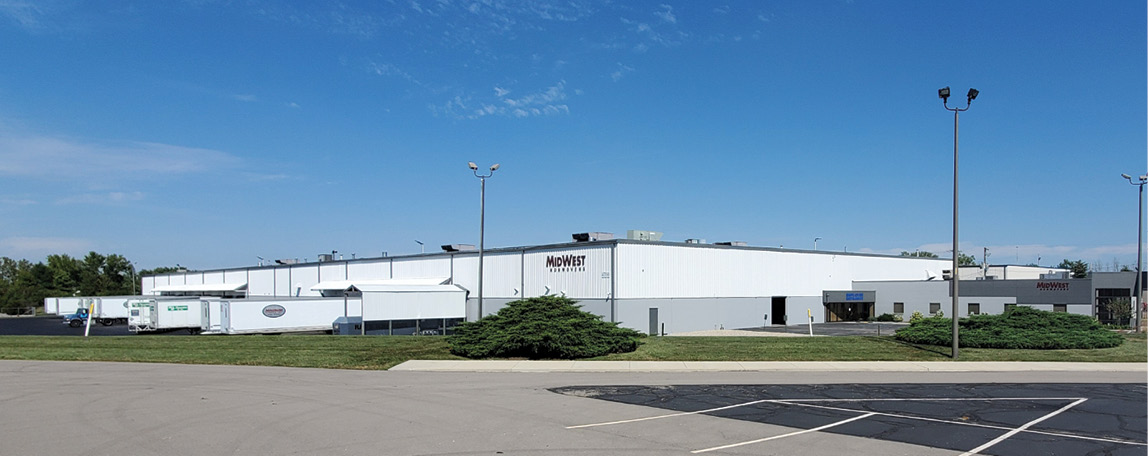
Company MidWest Nonwovens
Headquarters Sauget, Illinois
Founded 2008 by Bryan Speight and Chris Look
Ownership Privately held
Employees About 100
Production locations Sauget and Indianapolis
Specialty Filler for bedding, furniture, and other industries
Key brands Paladin, Cirrus, Malpaca, Joma Wool (not their product)
R&D Sauget and Indianapolis
Learn more midwestnonwovens.com
The owners of Sauget, Illinois-based MidWest Nonwovens—which sells batting, thermal and acoustic insulation, densified pads, wool, alpaca and other natural-fiber products, and fire-retardant barriers—like to joke that they make “white, fluffy stuff.”
“We make highly specialized materials that become part of other products,” says CEO Bryan Speight. “They may not always be visible to the end consumer, but they play an important role in performance, comfort, and compliance.”
While the company’s largest markets are thermal and acoustic insulation, sleep is a key part of the company’s portfolio, comprising 15% to 20% of its top line. Serving mostly small, family-run mattress businesses, Speight says MidWest Nonwovens prides itself on being a value-added supplier to its customers, offering FR barriers that meet the federal open-flame mattress standard, 16 CFR Part 1633, and get quilted into the top panel and borders of a mattress, plus foam replacement pads made from densified polyester fiber. The company also sells quilt batting made with wool, silk, cashmere, alpaca, and llama for the top of the mattress.
Born from adversity
MidWest Nonwovens was officially launched in December 2008, when Speight and co-owner Chris Look, who serves as chief operating officer, purchased a manufacturing facility in Sauget from Milliken & Co., a Spartanburg, South Carolina-based manufacturing firm that had recently bought the facility out of bankruptcy.
Speight’s history with the Sauget facility—formerly known as Western Nonwovens—and MidWest Nonwovens’ predecessor companies dates back another decade. In 1998, he had moved from his native North Carolina to the St. Louis area to work for Mid-America Fiber Company as a salesman (sales is still his de facto day-to-day role). Mid-America was purchased by Western Nonwovens a year later. Then Western Nonwovens was sold to venture capitalists in 2002, the same year Look joined the operation to run the manufacturing facility.
As part of that reorganization, Speight became a general manager and Look was named plant manager. After several years in that arrangement, in August 2008, Western Nonwovens filed for bankruptcy. “The company was shut down for approximately four months, and Chris and I were planning to start a new facility here in St. Louis,” Speight says. “But we received the opportunity to buy the Sauget facility we were both working in.”
The two men started with two production lines in the Sauget, Illinois, facility. At the time, the business was narrowly focused on furniture and bedding, but Speight and Look quickly realized they needed to diversify. “Mattresses and furniture are very price-sensitive markets,” Speight says. “We knew we could not build a sustainable business by competing on price alone, so we focused on quality, service, and diversification.”
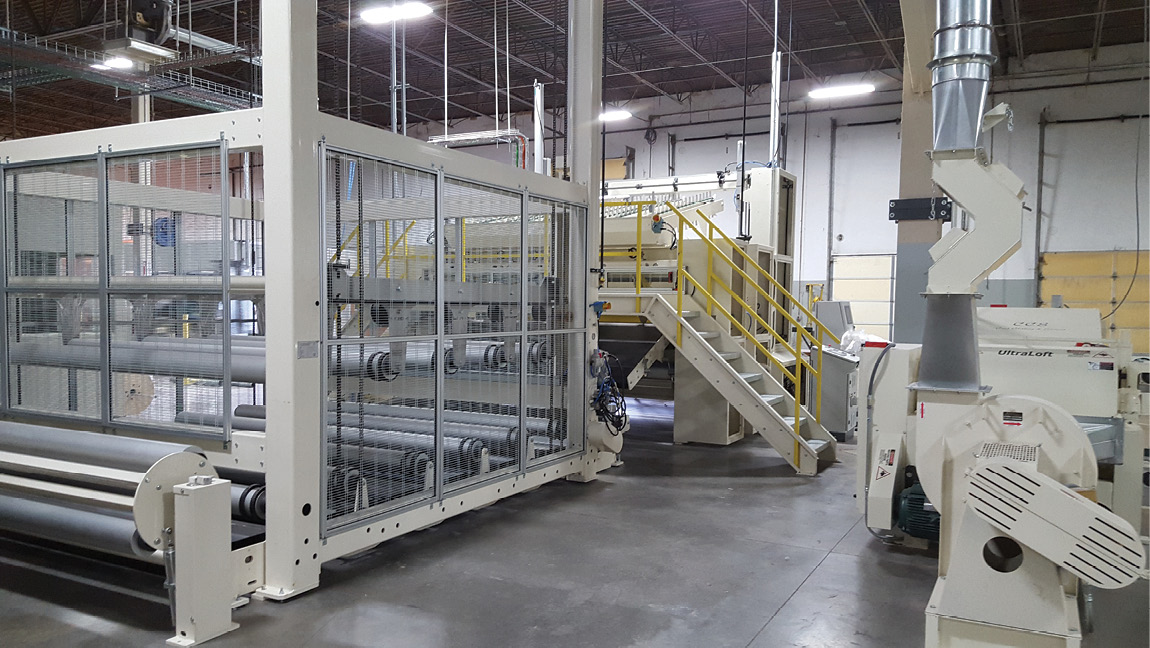
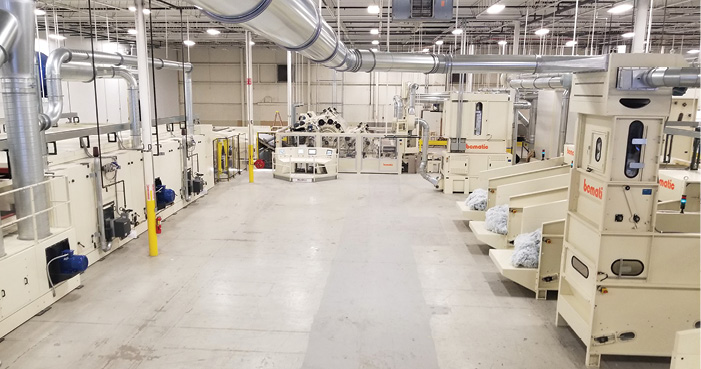
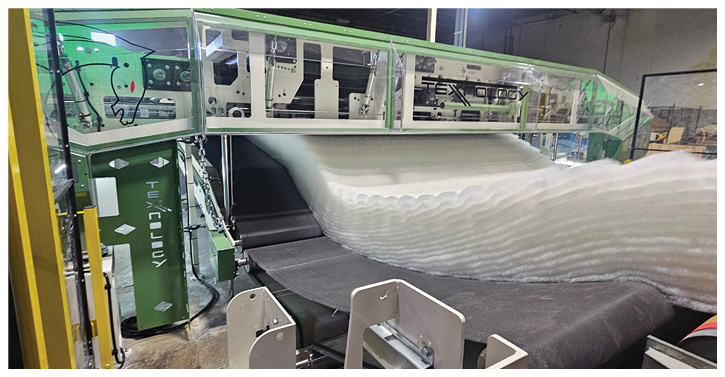
In 2011, MidWest Nonwovens bought out a competitor in Indianapolis and took over that company’s 50,000-square-foot building with one production line. They added a third production line in Sauget in 2015, then bought a new 135,000-square-foot facility in Indianapolis in 2018 and consolidated operations into the new building. They added a second 5-meter-wide production line in 2019 and an Airlay Densified pad line in 2024, both in Indianapolis—bringing the firm to six thermally bonded production lines. A seventh line, also in Indianapolis, makes soft goods such as pillows and cushion backs for outdoor furniture.
Also in 2024, sales executive Caroline Reeves joined MidWest Nonwovens to help further grow the business. “Caroline has been learning and traveling nonstop to develop relationships,” says Speight. “She has a larger-than-life personality and has been a phenomenal addition to our team.”
Made to order
More than 95% of MidWest Nonwovens’ products are made to order, according to its website, and its equipment allows for widths up to 135 inches at any length, with its newest line in Indianapolis allowing for rolls up to 185 inches wide.
Most of its customers are small manufacturing businesses with one or at most two manufacturing locations, and MidWest Nonwovens focuses on ensuring its customers have a streamlined experience.
“We can supply densified fiber pads, FR barriers, and filler cloth on one trailer,” says Speight. “That simplifies purchasing for our customers and reduces the number of suppliers they need to manage.”
MidWest Nonwovens makes and sells its FR barriers under the brand names Paladin and Cirrus, which are owned by Milliken & Co. They produce their alpaca under another brand and company—purchased in 2019—called Malpaca, which is in the all-natural alpaca pillow business. Their densified fiber product does not have a specific brand name. “Densified pads may not be the most glamorous product, but they are essential,” Speight says. “Our focus is making them consistent, reliable, and easy for customers to use.”
The company also supplies products: quilt batting made of Joma wool, a branded natural fiber sourced from New Zealand and used to make mattresses. These products are 100% natural and renewable; efficiently absorb and release moisture; provide warmth in the winter and coolness in warmer temperatures; and effectively resist dust mites, bacteria, mold, and mildew, according to the MidWest Nonwovens website.
In addition, the Indianapolis facility produces a handcrafted line of pillows, duvets, and mattress toppers under the Malpaca brand name. These products are made from 100% alpaca fleece and provide similar benefits as the Joma wool: They are moisture wicking, offer thermal regulation, and are hypoallergenic and naturally fire- and dust-mite resistant, according to the company’s website, which adds that its pillow covers are a blend of organic cotton and viscose from bamboo.
“It’s a standalone company,” Speight says of Malpaca. “People are starting to see the value of having alpaca fleece in your mattress. Wool has long had a place in mattresses, and alpaca fleece is gaining attention as another natural fiber option. We see real growth potential there, and we’re working to educate customers on its benefits. We had two live alpacas in our booth at ISPA EXPO in Orlando this year.”
Value proposition
Asked for the company’s mission, Speight is candid about the need to run a financially disciplined business, but he says profitability starts with doing the fundamentals well.
He adds, “Our philosophy is simple: Make the best quality product, operate efficiently, and take exceptional care of the customer.”
Speight and Look both grew up on family farms, Speight in Oakboro, North Carolina, and Look near Peoria, Illinois, where hard work was part of daily life. “Chris and I grew up getting our hands dirty,” Speight says. “That shaped how we run the business. You don’t cut corners. You do the work, take care of people, and keep getting better.”
As for the company’s approach to sales, MidWest Nonwovens works to deliver on what Speight describes as the four “pillars” of service, delivery, quality, and price.
He adds, “If you’re in a competitive product category, you have to be excellent at the fundamentals. For us, that means quality, service, and delivery first, with fair pricing as part of the overall value.”
“If you’re in a competitive product category, you have to be excellent at the fundamentals. For us, that means quality, service, and delivery first, with fair pricing as part of the overall value.”
—Bryan Speight, CEO, MidWest Nonwovens
Price is the fourth priority, Speight says, behind quality, service and delivery. “We can’t bring value to someone who is only buying on price,” he says. “Even the lowest price doesn’t matter if the product isn’t there when the customer needs it.”
Similar to its philosophy in building a congruently sized customer base, MidWest Nonwovens turns to smaller trucking companies instead of major carriers. “They have more of a vested interest in making sure we get on-time deliveries,” Speight says. “Usually, we pay a premium to our carriers to make sure [of that, too]. Our products take up a lot of space in a manufacturing facility, so customers rely on just-in-time delivery. In many cases, they are using material the day after it arrives.”
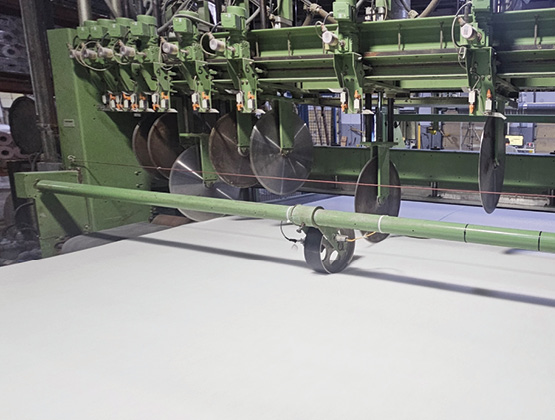
slitting machine.
The company’s value proposition is further based on the notion that a high-quality supplier needs a “phenomenal” quality program, Speight says, noting that MidWest Nonwovens is ISO 9001-2015 certified—something he and Look undertook to prove their bona fides, not because customers requested it. “Our quality team, led by Sarah Parlow, manages all the data and ensures we are producing to defined specifications and that Certificates of Analysis are being sent to customers that require them,” Speight says. “It’s a massive task managing and staying on top of our quality control program, as she holds everyone to the highest standards.”
As part of its comprehensive quality program, MidWest Nonwovens documents its data on a variety of fronts. “If someone says, ‘What’s your tolerance range on weight for the past five years for these products?’ we can go back, pull that data, and give them a percentage,” Speight says. “We collect and track data so we can support what we tell customers with documented history.”
With fewer than 50 other companies in the U.S. offering similar products, MidWest Nonwovens also differentiates itself through its investment in top-of-the-line equipment, Speight says.
“Every production line we’ve added has been new equipment. That investment gives us the consistency, efficiency, and quality our customers expect,” says Speight. “To be the kind of supplier our customers need, we have to keep investing in equipment, technology, and capacity. That requires a healthy business model and reasonable margins.”
MidWest Nonwovens has invested more than $20 million in equipment and technology, Speight estimates, adding, “We’re proud of that.”
Speight is careful not to predict exactly where MidWest Nonwovens will go next, but he says the company’s path forward will be guided by the same principles that shaped its growth to date: Listen to customers, solve real problems, and invest where the opportunity makes sense.
“We don’t try to force growth in one direction,” Speight says. “We listen to where our customers are pulling us, then we work with them to develop products that meet their needs.”
That customer-led approach has helped MidWest Nonwovens expand beyond its original markets and into new industries. “A lot of our growth has come from people calling us and saying, ‘We’ve heard about you. We know you do a great job, and we want to work with you,’” Speight says. “That’s how we’ve grown. We build the relationship, understand the need, and develop the right product.”
It is a practical approach, rooted in the same discipline Speight and Look learned early: Do the work, take care of the customer, and keep improving.
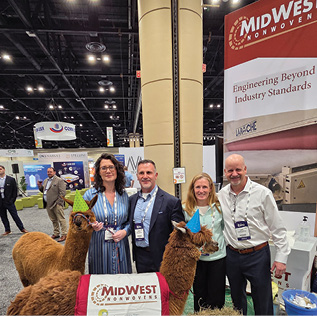
Show Animals
ISPA EXPO attendees who were not already familiar with MidWest Nonwovens likely remember the company for one of the most talked-about sights on the show floor: a petting zoo with two live alpacas in its booth.
The alpacas helped introduce attendees to Malpaca, the company’s line of pillows, duvets, and mattress toppers made with alpaca fleece. After their initial surprise, ISPA staff reviewed the logistics in advance, including liability coverage and on-site handlers, before approving the animals for the first day of the show.
“We had hundreds of people come by to see and pet the alpacas,” says CEO Bryan Speight, adding that many attendees stopped to take photos. “They became one of the biggest topics at the show. Our sales executive, Caroline Reeves, pulled it all together. She did an amazing job organizing the alpacas and explaining the benefits of alpaca fleece.”
The booth also gave attendees a hands-on way to learn more about alpaca as a natural fiber. Visitors could meet the animals, touch the fiber and watch informational videos about alpacas and how the company processes the fleece.
“It really brought the whole story together,” Speight says. “It caught people’s attention and helped them understand what makes alpaca fleece different.”
As for the next ISPA EXPO, Speight jokes that MidWest Nonwovens may have started a trend. “Next show, look for everybody to have some type of animal running around their booth,” he says.