Made up of 24 men and women from across the sleep industry, the International Sleep Products Association’s board is here to work for you. In this ongoing series, we’re introducing your board members, their thoughts on today’s industry challenges, and their goals during their board term.
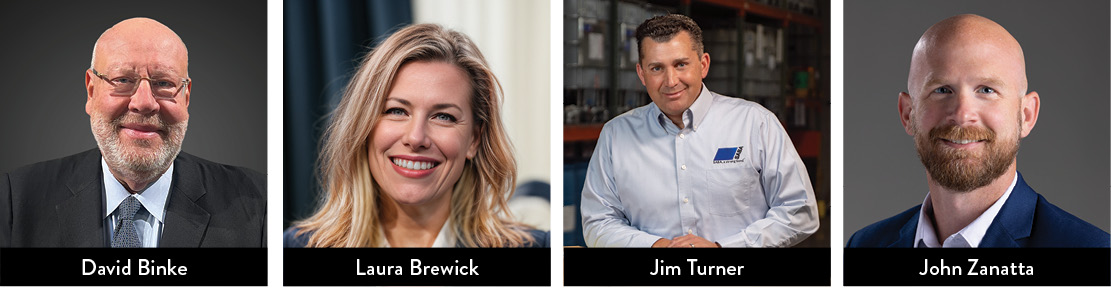
This month, meet David Binke, CEO, King Koil Licensing Co.; Laura Brewick, chief marketing officer and general manager, specialty and e-commerce, FXI; Jim Turner, CEO, SABA North America, LLC; and John Zanatta, vice president of sales, steel components, Leggett & Platt Inc. They, along with Chair Allen Platek, Vice Chair Michael Faus, and Immediate Past Chair Laurie Tokarz, are your executive committee members.
BedTimes: What drew you to serve on the board of ISPA?
David Binke: I wanted to help ISPA build a stronger future. Since I joined King Koil in 2017, we’ve focused on innovation and bedding solutions, emphasizing technology, wellness, and sustainability. We also have strong retail partners. I wanted to bring all that experience to the board in order to support our entire industry.
Laura Brewick: I wanted to be part of shaping what comes next for the sleep industry. I’ve spent a good portion of my career in this space, and I have a real stake in its health—not just for FXI, but for the entire industry. I’ve also genuinely valued the conversations that happen around that table and hearing the range of perspectives from people who care deeply about this industry. It makes the work better, and those discussions are where real advocacy gets shaped.
The industry needs to invest in building consumer trust, not just at the point of sale but across the entire discovery journey.
Laura Brewick, chief marketing officer and general manager, specialty and e-commerce, FXI
Jim Turner: I consider it an honor to serve on the ISPA board. SABA’s business in North America is closely tied to the mattress industry, so serving on the board is a natural extension of the work I do every day. One thing that has truly surprised me since joining is the breadth of ISPA’s impact. I had always viewed ISPA primarily as a networking and events organization, but I’ve come to appreciate that those activities are only part of its mission. From industry advocacy and mattress recycling initiatives to market intelligence and data analytics, ISPA plays a vital role in advancing and strengthening the sleep products industry.
John Zanatta: I joined the bedding industry a little more than 10 years ago and was immediately impressed with the community’s dedication to improving and advancing our market. When the opportunity presented itself to work on behalf of this group, I was thrilled with the chance to do my part in helping us all move forward.
BT: What unique perspective or expertise do you bring to this board?
Binke: I have a strong understanding of wholesale and retail and pride myself on getting the job done correctly. Since joining King Koil, I’ve reimagined what it could be and repositioned its business model as an ultra-premium luxury brand. My background is in selling upper-end products and understanding the marketing behind them and working with retail partners who understand how to sell higher-quality, better products. I also bring strong international knowledge: King Koil around the world is actually far larger than it is here in the United States, even though we’ve grown exponentially here over the last several years.
Brewick: My background spans product development, sales, and marketing across multiple channels, which gives me a view of the full consumer journey—not just how sleep products are made, but how they’re sold, positioned, and experienced. I’ve watched this category evolve significantly, and I bring that end-to-end perspective to every board-level conversation.
Turner: Building a mattress requires contributions from a remarkably deep and diverse supply chain. While mattress brands, foam, and fabrics are often the most visible parts of that process, there are countless specialized suppliers whose products represent only a small portion of the finished mattress but are essential to its performance and efficient production. I bring the perspective of those suppliers to the board. As an adhesive manufacturer, SABA may not be the first company people think of when they think about a mattress, but our products play an important role in manufacturing, and our success is closely tied to the health of the broader bedding industry. I believe it’s important that every part of the supply chain has a voice.
Zanatta: Although I have been in the industry for 10 years now, compared to my colleagues I’m a newcomer to bedding. I plan to come in with a new perspective and perhaps challenge some long-held assumptions for how ISPA can continue to be a guiding force within bedding.
BT: What is the biggest challenge facing our industry in 2026?
Binke: I think the greatest challenge is retail and wholesale consolidation and the effects those are having and will continue to have on the marketplace.
Brewick: There is a convergence of pressures that we have faced this year: supply chain disruption, soft demand for longer than expected, and fragile consumer confidence. But the issue I think about most from where I sit across marketing, e-commerce, and specialty is the erosion of category credibility. When a consumer can’t tell the difference between a quality product and a $150 import with 4.5 stars and 10,000 reviews, we have a consumer education problem at scale. It commoditizes the category, drives price compression, and ultimately hurts every legitimate manufacturer in the market. Add to that the artificial intelligence-driven content and review environment that make it even harder for consumers to navigate, and the stakes of getting this wrong are significant. The industry needs to invest in building consumer trust, not just at the point of sale but across the entire discovery journey. That’s where I think ISPA’s advocacy and education role becomes as important as its other roles.
Turner: The greatest challenge continues to be the prolonged decline in U.S. mattress production. Lower demand affects every segment of the industry, from manufacturers and suppliers to retailers and service providers. While many organizations have done an impressive job adapting to difficult market conditions, sustained growth depends on renewed consumer confidence and a healthier demand environment. As an industry, we also need to continue investing in innovation and collaboration, so we’re well positioned when the market rebounds.
Zanatta: Looking beyond our current economic climate, the biggest challenge I see is the fragmentation and commoditization of the mattress market. Innovation and product differentiation were the driving force behind our industry’s success. That has been replaced with price compression and search rankings.
BT: What accomplishment are you most proud of in your career?
Binke: I’m most proud of the fact that I’ve been a successful CEO for two companies over the last 15 years. I started my career in buying and management before focusing on the sleep industry. It’s been an honor to have the opportunity to grow and expand our brand in the United States and internationally.
Brewick: I’ve had the good fortune of working alongside and leading great teams across several brands, and when I think about what makes me most proud, it comes down to personal impact. Whether it’s helping a consumer find the right solution for their needs or helping someone on my team advance in their career, those moments matter most to me. There’s nothing quite like hearing directly from someone that something you did made a real difference in their life.
Turner: Without question, it’s helping build SABA North America from the ground up. SABA is a European company with a long and successful history, but our North American business began in 2008 with very humble beginnings. We processed our first orders from my basement, and nearly two decades later we’re privileged to serve customers throughout North and South America. While I’m proud of what we’ve built, I’m even more grateful for the people who’ve built it with me. Our team has become like an extended family, and sharing that journey with them has been the most rewarding part of my career.
Zanatta: I’m most proud of the first time my name was included on a bedding product patent. We all put ourselves into this industry through customer service, partnerships, and generally working together to help people sleep better. But to create something new that didn’t exist before is an amazing feeling.
BT: What do you hope the board achieves during your term?
Binke: We recently expanded ISPA’s membership model to include owners, executives, and managers of bedding specialty shops, department stores, and furniture stores that sell mattresses directly to consumers. I’m looking forward to further getting retailers involved financially and strategically with ISPA.
Brewick: Two critical areas I would like to see ISPA have an impact on are the advocacy around consumer product safety and the new membership structure. I’d like to see ISPA’s new membership structure take hold and bring in the retailers and partners who are shaping how consumers buy today. Doing so will make ISPA a stronger, more representative association, which is what gives us the standing to fight those advocacy battles.
Turner: Like everyone in our industry, I’d certainly like to see the market recover and return to more normalized levels of mattress production. While the board can’t control broader economic conditions, ISPA can continue to advocate for policies that promote a fair and competitive marketplace. That includes supporting domestic manufacturers, encour-aging consistent product safety standards, and addressing unfair trade practices when they exist. If during my term we can help strengthen the industry’s long-term competitiveness and create a more level playing field, I’ll consider that meaningful progress.
Zanatta: I would like to see the board continue to focus on consumer safety. Better sleep is always the top priority, but I worry that there are corners being cut to stay cost-competitive. Recent independent flammability testing had an alarmingly high failure rate for a safety standard that’s been in place for the better part of two decades.
BT: What is something industry colleagues would be surprised to know about you?
Brewick: That I am a descendant of Eve Earnest, who was taken captive by Delaware Indians in 1777 and brought to Fort Detroit to be traded to the British. She was freed at the end of the Revolutionary War and traveled back to Bedford County. Much of my large extended family still resides across central Pennsylvania.
Turner: Here’s a fun one: I’m currently writing a book with my parents and siblings. It’s based on a series of unusual experiences our family had growing up. Let’s just say I didn’t need to watch scary movies to have a ghost encounter! We’ve turned those stories into a family project, and we’re hoping to have the book finished and published this fall.
Zanatta: I like to run—a lot. I have competed in half-marathons and marathons, recently completed a 50K (31 miles), and completed a 50-mile race at the end of this past summer. Training your body is easy. Training your mind to overrule your body when it’s ready to be done is the big challenge.