
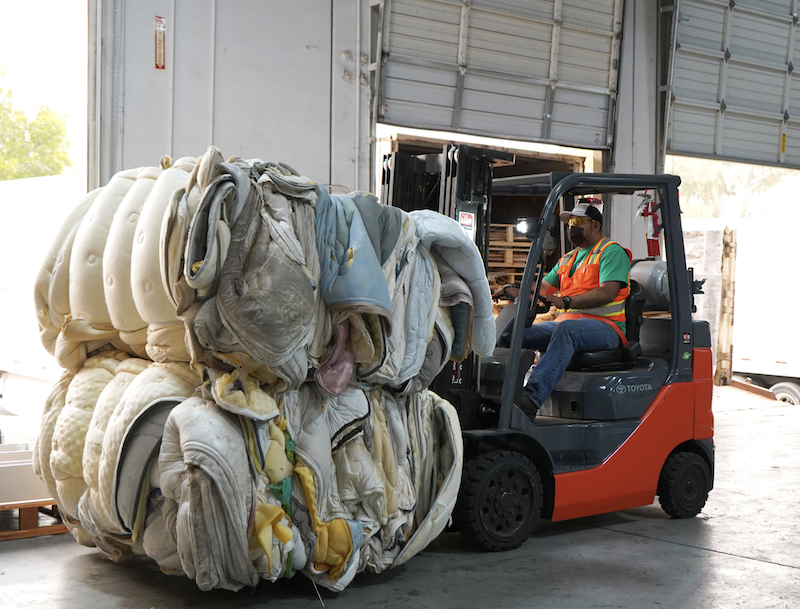
Every mattress eventually reaches the end of its useful life. What happens next depends partly on decisions made years earlier, when suppliers select materials and manufacturers determine how to assemble them.
That connection is especially relevant on November 15, America Recycles Day. Organized by Keep America Beautiful, the annual observance encourages Americans to recycle more, reduce waste, save energy, and conserve natural resources.
For the mattress industry, those goals extend well beyond collecting discarded products. They touch nearly every stage of a mattress’s life, from material selection and manufacturing to recovery and recycling.
Turning discarded mattresses into resources
More than 50,000 mattresses are discarded in the United States each day, according to the Mattress Recycling Council (MRC). While their size and construction create disposal challenges, much of the material inside them has value beyond its original use.
MRC, a nonprofit organization created by the International Sleep Products Association (ISPA), operates statewide mattress recycling programs in California, Connecticut, Rhode Island, and Oregon.
Since its first program launched in 2015, MRC has made significant progress in recovering materials that would otherwise enter the waste stream.
At participating recycling facilities, workers and specialized equipment dismantle mattresses and separate recoverable components. Those materials can find new uses:
- Steel: Recovered metal can return to manufacturing.
- Foam: Recycled polyurethane foam can be used in carpet padding and other products.
- Fibers: Recovered textile materials can be repurposed for other applications where viable markets exist.
Not every component can be recovered, however, and collection and processing have environmental costs of their own.
Still, MRC’s life-cycle research on its California recycling operations indicates that using recovered mattress materials in place of newly produced materials can reduce energy consumption, conserve water, and lower greenhouse gas emissions.
Reducing waste before it happens
Recycling is only part of the picture. Manufacturers and suppliers also influence how much waste enters the system and how easily materials can be recovered later.
Material combinations, adhesives, construction methods, and product design all affect the process of separating mattress components. Improving recyclability requires a better understanding of those relationships without compromising comfort, performance, durability, or safety.
MRC supports that work through research aimed at improving collection and dismantling methods and finding new uses for recovered materials.
Projects exploring ways to turn discarded polyurethane foam into new polymers or useful industrial materials offer promising possibilities. Some remain in development, reflecting a central industry challenge: A material’s technical recyclability does not automatically mean an economically practical recycling market exists.
Opportunities also exist on the manufacturing floor
MRC’s voluntary Sleep Products Sustainability Program (SP2) helps mattress manufacturers examine their operations, reduce waste, and identify opportunities to improve efficiency. The program provides training, resources, and facility certification at no cost to eligible California-based manufacturers.
The principles extend beyond program participants. Tracking production scrap, evaluating material use, reducing energy consumption, and improving waste handling can help manufacturers identify inefficiencies while conserving resources.
Connecting efforts across the industry
No single company can tackle these challenges alone. Progress depends on cooperation among businesses that design, manufacture, supply, sell, and eventually recycle mattresses.
ISPA supports that work through its Sustainability Committee, which brings manufacturers and suppliers together to examine environmental challenges, share information, and recommend industry priorities.
The association also provides research and educational resources, including its glossary of sustainability terminology, and brings industry professionals together through its annual Sustainability Conference. The September 2026 conference explored topics ranging from circular product design and recycled materials to manufacturing efficiency, recycling infrastructure, and environmental policy.
These discussions help connect decisions made at different points in a mattress’s life. Suppliers can better understand recycling challenges, manufacturers can evaluate material and construction choices, and recyclers can share what they learn about recovering materials more efficiently.
Considerable work still lies ahead
Recycling infrastructure remains uneven across the country, and finding reliable markets for recovered materials continues to be a challenge. But the industry’s experience demonstrates what coordinated efforts can accomplish.
America Recycles Day offers a reminder that reducing waste is not simply about what happens when a product is discarded. It is also about how that product was designed, how efficiently it was made, and whether its materials can serve another purpose.
For the mattress industry, those decisions offer opportunities to conserve resources, reduce waste, and make better use of materials already in circulation.