
In an industry increasingly shaped by private equity buyouts, national retail consolidation, and manufacturing moved overseas, a notable number of bedding and mattress companies remain proudly family owned—as a business strategy, not just a heritage story.
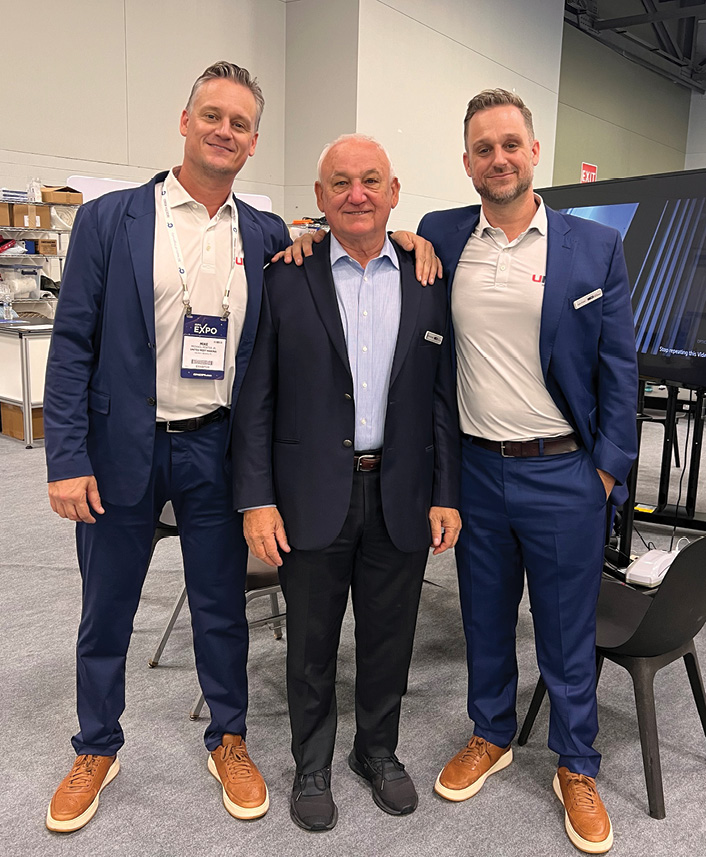
At United Mattress Machinery in Delray Beach, Florida, the education started early. Sam Porter and his brother, Michael Porter Jr., spent school vacations on the factory floor long before either held a title. Today, they run the company alongside their father, Michael Porter Sr., as the third generation, carrying forward a business with roots stretching back 125 years.
But “family” doesn’t always mean blood, and it doesn’t always mean one household. In Baton Rouge, Louisiana, Lee and Kim Burns founded Mattress Direct 25 years ago. Two years in, close high school friends Allyson and Ty Hingle joined as partners, Ty leaving a pharmaceutical career to work alongside the Burnses full time. The company is still owned by the two couples, now running 17 locations across two states with 65 employees. Even the marketing stayed in the family: Kim and Allyson still shoot the company’s TV commercials, though Allyson, who works as a nurse, isn’t involved day to day.
A little more than 1,000 miles up the east coast, Richard Diamonstein grew up absorbing lessons from his father that never made it into a manual. He’s now managing director of Paramount Sleep Co., a company based in Norfolk, Virginia, that has been in his family since 1935. Its defining moment came from near-collapse, when the COVID-19 pandemic wiped out 90% of retail sales overnight, and it was his father’s counsel, not a board vote, that kept the doors open.
In Beloit, Wisconsin, Ryan Poppie runs Beloit Mattress Co. with his wife, Angelica, and their three daughters at his side—sometimes literally, since his newest employee is his first grandchild, whom he says was sitting on his lap as he answered questions for this article.
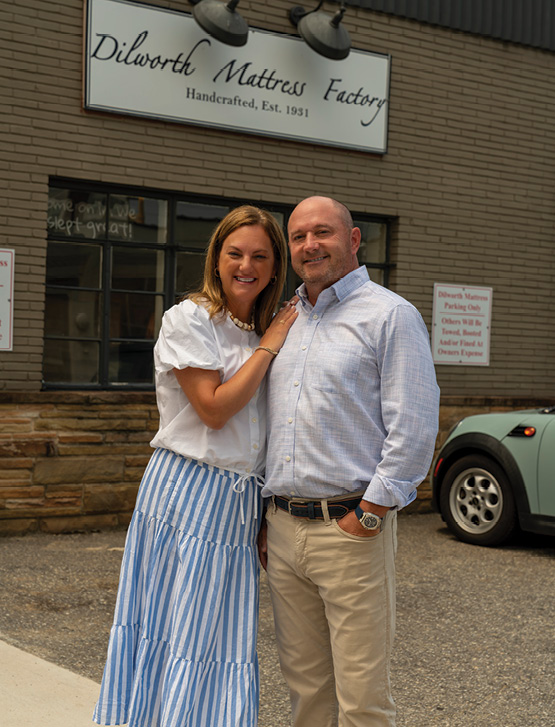
Scott and Dori Hirsch run Dilworth Mattress Factory in Charlotte, North Carolina, a fourth-generation institution that Scott’s great-grandfather started 95 years ago as a repair shop. The family began building mattresses in the 1960s.
At Purecare in Phoenix, family looks a little different still. Sean and Sarah Bergman didn’t inherit the business by blood—they built their partnership into it. Purecare (originally Fabric Tech) was founded in 2000 by industry veteran Sam Chase, who made mattress protectors as a way to help fight his grandchildren’s allergies. After Chase died in 2005, the business brought in Sean’s father, Jeff, as a partner. Sean came on board soon after, unpaid for the first year, on the promise of a future partnership. His girlfriend, Sarah, later joined to lead rebranding; the two married and today run the 70-employee company as its second generation.
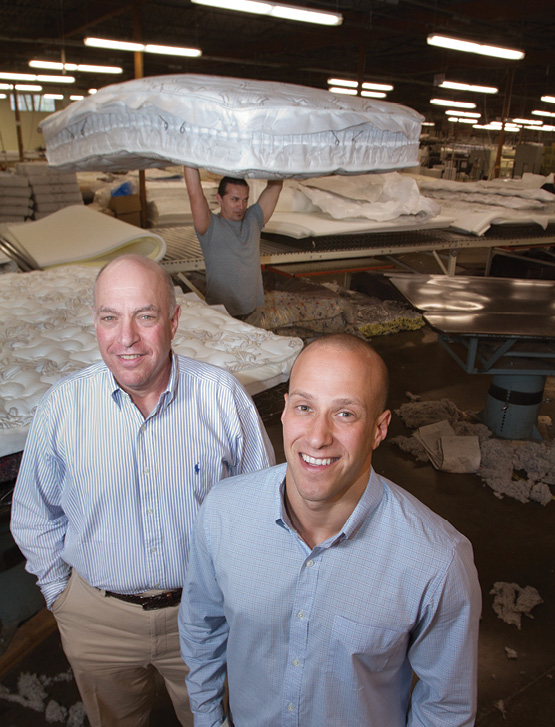
And in Hartford, Connecticut, Robert Naboicheck runs Gold Bond alongside his son and company president, Skip. The two are continuing a line of father-son leadership stretching back 128 years to Isadore Naboicheck, a Ukrainian immigrant who founded the business with a dream to build the region’s most comfortable mattress.
The case for family ownership
For family-owned brands, the family name stands behind the company name, which means every product carries a personal guarantee. With just 30 employees at United Mattress, that guarantee is built on trust and honesty. “I think we can be pretty honest with each other,” Sam Porter says. “You’re just running a company and making choices together.”
Honesty extends outward to customers and partners, too. At Paramount Sleep, Diamonstein explains its company philosophy this way: relationships over shareholder returns, built from ties to customers, employees, and even competing family businesses.
Proximity is what matters most to Ryan Poppie. Two of his daughters worked in other states before coming back to Beloit, and now his daughter Cari brings her infant son to the shop most days. “The greatest benefit is that it keeps our family close,” he says.
Dilworth Mattress Factory has compounded trust across generations of customers, not just family: The Hirsches have stayed within a three-block radius of Charlotte for all of the business’s 95 years. “I love to hear the stories about how someone’s grandfather bought a mattress from us and now they’re going to buy one, too,” Scott Hirsch says.
Mattress Direct’s Lee Burns sees that same personal thread running through retail generally and thinks the industry underestimates how much customers still want it. He and his partners have built their two-family business on that bet. Despite self-checkout creep at big-box stores, drugstores, and clothing chains, where a customer can shop and leave without speaking to anyone, Burns doesn’t buy into the idea that that’s what people want.
“A lot of people think customers don’t want to deal with a salesperson,” he says. “It’s really the complete opposite. They are typically armed with data and want to ask questions and have us help to execute.”
Sean Bergman describes the closeness in blunter terms: It’s a full-time work-life partnership. “You are a family first, and then you build this business together that becomes the joint future,” he says. That kind of accountability is hard to manufacture when a business answers to shareholders who might never touch the product.
Playing the long game
Publicly traded companies answer to quarterly earnings; family businesses answer to the next generation. Michael Porter Sr. learned that lesson when he took a three-year contract with a larger corporation when his sons were in high school. “That was not a great experience for me. It was difficult to adjust,” he says.
When the contract ended, he restarted the family business, and his sons came aboard—happier, they say, once it was family-owned again.
Diamonstein points to the same instinct at Paramount Sleep—doing right by customers and employees year over year rather than chasing a quarterly number.
From his viewpoint, Lee Burns—who worked in retail and mattress sales for two other companies before starting his own—says that for his larger, national competitors, running those companies would be “almost like flying a Boeing 757”—hard to bank and turn when a local market shifts. A two-family, locally rooted company like Mattress Direct, however, can feel that shift and respond directly because the owners live in the market themselves. For example, during economic downturns, local companies tend to have more leeway in cost negotiation than larger national operations.
Knowledge that isn’t in a manual
Ask a family-run bedding company how the current generation learned the craft, and the answer is rarely “a training program.” Instead, a parent or a grandparent has passed down decades of experience at the same machines currently in use. “We were always around the machinery on the factory floor,” United Mattress’s Sam Porter says. This is the kind of institutional knowledge larger competitors struggle to replicate.
For Diamonstein, absorbing counsel from his father shaped how he leads Paramount Sleep today. “It’s that kind of grounding that gave me the confidence to make hard calls when the business needed them most,” he says.
Dilworth Mattress Factory still makes its mattresses in the back of its showroom, including custom-built options for everything from recreational vehicles and yachts to bunk beds. The breadth of its institutional knowledge shows up almost literally on the label, says Scott Hirsch: “One client had a mattress we were pretty sure was from the 1980s, according to my uncle’s evaluation of the label.”
For Lee Burns, knowledge also points outward: He advises other family owners to run their companies with the discipline of a large business while keeping the local charm. He’s candid that 25 years hasn’t come without failure and credits buying groups like Nationwide Marketing Group with connecting Mattress Direct to “like-minded folks” among independent dealers to learn from. (For more on buying groups, see “Where Data Is the Differentiator.”)
Moving fast when it matters
Without layers of corporate approval, family businesses can often make decisions in days that could take larger companies months to make. “You can move quicker and change direction faster. We can trust our gut more,” says United Mattress’s Sam Porter.
His father points to results. The company ranks second in OEM (original equipment manufacturer) businesses on LinkedIn, ahead of far larger competitors. “We must be doing something right, because we’re toe-to-toe with the giants,” Michael Porter Jr. adds.
At Purecare, Sean Bergman describes a similar loop—dinner with his father and Sarah, a quick conversation about where the business needs to go, and a plan in place within a couple of hours—a turnaround that would take a corporation weeks to reach.
At Beloit Mattress, Cari Engel’s pregnancy made the point personal. When her son was born, there was no human resources policy to navigate and no hoops to jump through. “We simply adjusted her schedule and created space for her and Matthew,” Ryan Poppie says. “We can make decisions in minutes that would take weeks of meetings and approvals elsewhere.”
A workforce built on trust, not scale
Turnover is one of manufacturing’s persistent headaches—but it happens much less at family-owned shops. “We have a stringent hiring process. We value quality over quantity,” Sam Porter says, describing a team that’s “very family-oriented” and quick to help each other through medical emergencies or issues with kids.
Diamonstein describes a similar formula. When pandemic-era retail sales collapsed, Paramount shifted its employees into producing hospital gowns and masks, then into landscaping and repainting offices, rather than laying anyone off.
Mattress Direct’s hardest test came in 2005 after Hurricane Katrina, when its New Orleans-area team members lost homes and, in some cases, everything they owned. Employees moved in with co-workers to share what housing was left, and vendor partners, unprompted, called to help—one mailed a rent check, others shipped bedding so displaced workers had something to sleep on. “We’ve got amazing vendor partners who are just always willing to jump in and figure out how they can help,” Lee Burns says.
Dilworth Mattress Factory runs lean by design. “With four staff altogether, an appointment-only, boutique showroom rather than a big-box footprint, there’s limited overhead because you don’t have to be there all the time,” Scott Hirsch says.
At Gold Bond, trust gets built through training—and not just any kind of training. New hires are heavily immersed in the business in the Hartford factory before going on the road—a contrast, Naboicheck said, to bigger brands that put new reps on the road straightaway to “pick things up.”
Dealers and retail sales associates also come in for hands-on training sessions alongside sales reps. That process paid off when a Gold Bond salesperson of 18 years finally got a longtime retailer to try the latex line.
“This is what I mean about the importance of intensive, hands-on product training, face-to-face communication, and taking the time necessary to help the next generation of a family business transition into leadership,” says Naboicheck. “The retailer had recently taken over from her dad, who is semi-retired. … She laid down on the product and said, ‘This is a wow mattress! Everybody needs this on their floor!’ She has now added our most expensive 11-inch latex product to her lineup in king size. This underscores my belief that you can never replace the personal connection that a family business like ours can deliver.”

The succession question and clear lines
Still, family ownership isn’t without friction. The same closeness that builds trust and loyalty in a company can also complicate succession and blur the line between the dinner table and the boardroom.
Three generations deep already, United Mattress shows how that tension can be resolved over time. “I worked for my father, and now my sons work with me,” Michael Porter Sr. says. “There were things I liked and disliked about working with my father. So, the things I didn’t like, I didn’t carry over.” Today, his sons say they never considered doing anything else.
Ryan Poppie is candid that the closeness at Beloit Mattress cuts both ways. “One of the top issues is keeping clear boundaries between work and home,” he says, invoking Dave Ramsey’s philosophy of switching from “business Dave” to “husband and father Dave” before walking into the house after work. “The relationships are what matter most in the long run,” he says.

No one frames the boundary question quite like the Bergmans. “We’ve always been able to draw a line between personal and business. We can be mad at each other at work, but the minute we leave work, we’re at home,” Sean Bergman says.
Sarah Bergman agrees, and says it comes down to respect for a partner’s talents.
Meanwhile, Sean Bergman sees something less tangible than economics as the real constraint in business and family relationships—in hard times, a leader is carrying not just the company, but also a parent’s retirement or the prior generation’s security. “That’s not for everybody,” he says. “It’s a lot of pressure, and we’ve been very lucky to rally together and work it out.”
At Gold Bond, Robert Naboicheck believes in the power of reverse mentoring. His advice: Listen to the next generation, and don’t just teach them. For example, he credits his son with understanding how today’s customer shops in ways his own decades on the floor can’t match. “It’s imperative to understand the perspective of the next generation, because they are closer to and more in tune with today’s consumer,” Naboicheck says.
Competing without the marketing budget
Family-owned companies rarely have the marketing spend or retail leverage of national chains and private-equity-backed brands. United Mattress competes on relationship. “People call us and we answer the phone. We give all our customers our personal cellphone numbers,” Sam Porter says.
At Dilworth Mattress Factory, Scott Hirsch agrees they cannot compete with the marketing dollars of the larger companies, but they can focus on Dilworth’s reputation, which speaks for itself—quality over volume, with a sales approach that’s deliberately low-pressure. “I can just about guarantee you that if someone says they want to think about it and get back to us, they do,” he says.
Lee Burns frames the same trade-off as grit rather than scale. Mattress Direct can’t match a national chain’s advertising budget but makes up the difference in adaptability, reading the local market in real time rather than following a corporate calendar. Total accessibility has been the equalizer for Beloit Mattress, too—real people answering the phone six days a week.

Gold Bond competes on the product itself: two-sided mattresses with edge-to-edge steel and hand hog-ringed coils, rather than the glue-and-foam construction that Naboicheck says lets larger manufacturers finish a mattress in under 10 minutes. It backs the difference with 15-year warranties—five years longer than industry standard—and remains one of the few mattress makers that still mechanically processes its own raw cotton in-house rather than buying it pre-processed.
Sean Bergman sums up the trade-off as his top advice to other family businesses: Know your core expertise and stay on that path.
“Continuity from one generation to the next is a strong differentiator that can sometimes be hard to describe,” adds Robert Naboicheck. “Family businesses like ours simply have a different culture. You can feel the passion and focus on legacy and personal values that have been ingrained across decades and generations.”