If the word “sustainability” feels big, complicated, and maybe even a little overwhelming, you’re probably not alone.
Where do you start? Materials? Packaging? Recycling? Carbon? Compliance? Data? And how do you balance all of that with the realities of running a business, controlling costs, and making a mattress that, first and foremost, provides a great night’s sleep?
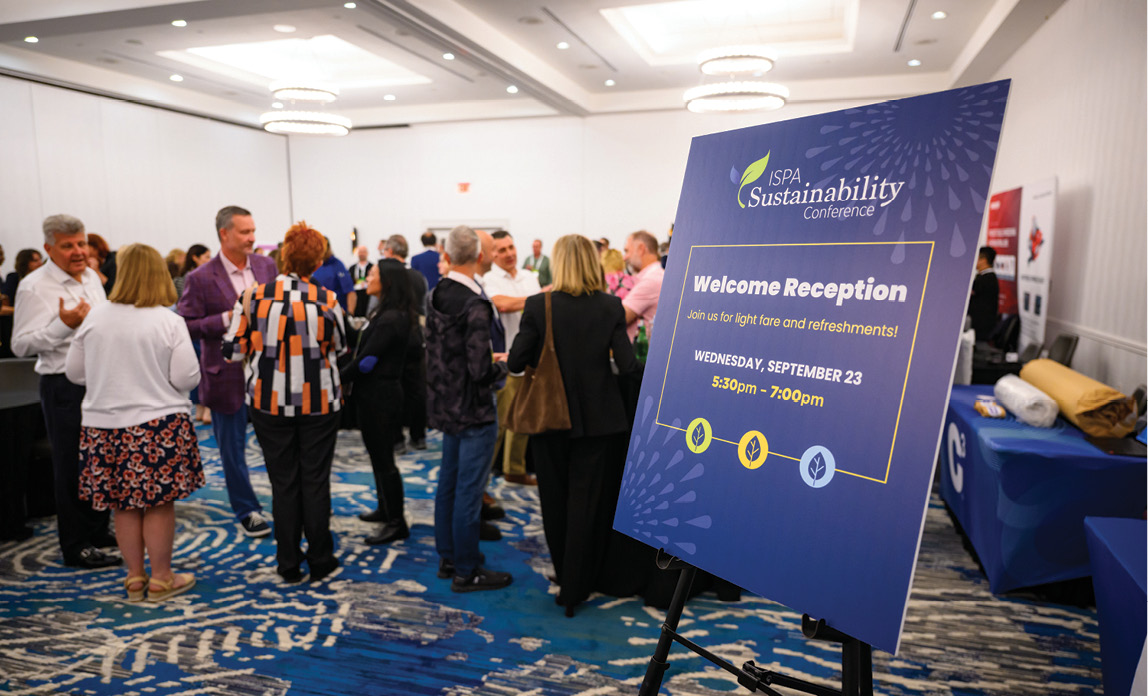
Those questions were very much part of the conversation at the International Sleep Products Association’s 2026 Sustainability Conference, held Sept. 23–24 in Charlotte, North Carolina. Over a day and a half, manufacturers, suppliers, recyclers, equipment companies, sustainability experts, and bedding associations from the U.S. and abroad tackled everything from adhesives and circularity to extended producer responsibility, packaging, consumer expectations, and artificial intelligence.
We heard from companies and organizations tackling individual pieces of a very big puzzle. Some are developing materials that are easier to recycle. Others are finding uses for production scrap, reducing packaging, improving traceability, or simply getting better at collecting the right data.
No one has it all figured out. But they’re all starting somewhere. And maybe that’s the most useful takeaway. We were all beginners at something once. Sustainability is no different. The goal shouldn’t be to build the perfect road map before taking the first step. It should be to figure out what makes sense for your organization, start there, and keep moving.
Here are six places to consider.
1. Think about the end at the beginning.
Jim Turner, CEO of SABA North America, kicked off the conference with a great illustration of one of the mattress industry’s biggest sustainability challenges.
For virtually all of a mattress’s useful life, the adhesive has one job: Do not come apart.
It has to survive manufacturing, shipping, and years of nightly use. Then, at the end of the mattress’s life, a recycler needs pretty much the exact opposite. Suddenly, we want those materials to separate as easily and cleanly as possible. That’s quite the design challenge.
SABA is exploring solutions through mono-material design, using adhesives from the same material family as the foam or pocket-coil fabric they bond. Research presented with Dow also showed that the adhesive selected during manufacturing can affect chemical recycling years later. SABA even previewed a peelable foam adhesive designed to hold when it needs to hold but peel apart by hand when the product reaches end of life.
And SABA wasn’t alone. Bekaert Deslee showed ReCover, a cover sewn with thread that dissolves under heat so it can be more easily disassembled. Masias Maquinaria shared technology that turns foam and textile scrap into materials that can go back into mattresses.
The takeaway is that what we decide upstream affects what is possible downstream.
Erin Faulk, textile engineer for Tempur-Sealy’s Advanced Development Team, said, “I’m interested in turning sustainability from a marketing problem to an engineering problem. How can circular design save us money, increase efficiency, and create a better product for both people and the planet? I’m starting small by educating myself and my colleagues in product development, taking stock of our current product, and asking: What’s one simple change that can make a big impact? What is the easiest next step toward circular design?”
Where could you start?
2. Find the business opportunity, not just the sustainability story.
Nellie Cohen, founder of Baleen Advisory Services, brought another perspective to the conversation: For circularity to really scale, it has to work for the business and the customer, too.
She pointed to examples outside our industry, including Patagonia’s Worn Wear repair and resale program and Lowe’s HomeCare+ subscription service. What was interesting about the Lowe’s example in particular is that the company isn’t necessarily selling consumers on “circularity.” It’s selling convenience and service—and that distinction matters.
Sometimes we get so focused on making the sustainability case that we overlook the business case. Can an initiative save money? Reduce waste? Build loyalty? Solve a customer’s problem? Create a service or revenue stream that didn’t exist before?
No one has completely figured out what the circular business model for a mattress looks like. Cohen essentially left that space marked “TBD.” For some, “TBD” causes discomfort, but reframed, it could signal opportunity. It means there’s room for this industry to figure it out.
Cohen gave attendees a wonderfully simple assignment: Have coffee with three people in parts of your company you don’t know particularly well. Ask what keeps them up at night. Then ask whether circularity might help solve one of those problems. That sounds like a manageable place to begin.
3. Regulation isn’t waiting for us to catch up.
If some of the conference conversations felt exploratory, the policy discussion certainly did not. Sustainability is quickly becoming much more than a corporate initiative or marketing conversation. It’s an operating issue.
ISPA President Alison Keane and Shawn Swearingen, ISPA’s director of policy and government affairs, walked attendees through extended producer responsibility (EPR) activity around the country, as well as packaging EPR, climate disclosure, PFAS, flame retardants, recycled-content requirements, formaldehyde, and other issues affecting the industry.
Paige Flanagan of rePurpose Global broke down packaging EPR and all the pieces that can come with a mattress in a box: corrugated cardboard, compression film, protective bags, straps, corner guards, and more. Different materials can mean different reporting and fee requirements.
Then there’s Europe.
Frederik Lauwaert of the European Bedding Industries’ Association discussed the European Union’s Ecodesign for Sustainable Products Regulation and emerging requirements around durability, recyclability, recycled content,
and product information, including Digital Product Passports. One point from EBIA was especially important: “Comfort first.”
Sustainability cannot come at the expense of the fundamental reason the product exists—a good night’s sleep.
So, where do you start if regulations aren’t your area of expertise? Perhaps you need to figure out who in your organization owns this? Who is watching what is changing? And are operations, product development, finance, sales, and marketing talking to that person?
Those are much easier questions to answer than “What is our comprehensive regulatory sustainability strategy?”
4. Your sustainability story is becoming part of your sales story.
This was one of the areas that really got my marketing brain going.
Suzanne Shelton, senior partner at ERM Shelton, shared research showing that 86% of U.S. senior business buyers surveyed said knowing a supplier leads in reducing its environmental impact improves their opinion of that supplier. Even more interesting, 83% said sustainability sometimes or always breaks the tie between competing suppliers. That makes sustainability a sales issue, too.
For consumers, the language may be different. Shelton’s presentation showed that much of the online mattress conversation around these issues centers on health and wellness—fiberglass, off-gassing, flame retardants, PFAS, and microplastics.
And then there’s AI, of course. Shelton asked three AI assistants which mattress was the most eco-friendly. Each came up with its own criteria and different recommendations based on the information it could find online.
Think about what that can mean for your brand. A consumer may be forming an opinion about your product’s sustainability story without ever visiting your website, talking to your salesperson, or walking into a store.
And here’s a sobering—even frightening—statistic Shelton shared: Up to 80% of online searches end in zero-click. That means a user gets an instant answer on the search engine results page and doesn’t click on anything else. They leave with whatever AI served them.
So take a good, hard look at your company from the outside. What information is actually available? Are your claims specific and supportable? Can a retailer understand them? Can a consumer? Can your own sales team explain them? And, increasingly, can AI?
You don’t need the perfect sustainability story before you communicate. But you do need to make sure your story is clear, credible, and true. No fluff. Real stuff.
You don’t need the perfect sustainability story before you communicate. But you do need to make sure your story is clear, credible, and true.
5. Not every innovation has to change the world.
Sometimes “innovation” makes us think we need to invent something no one has ever seen before. But conversations at the conference offered plenty of reminders that progress can be much more practical than that.
RoCo demonstrated a way to turn polyurethane foam scrap into recycled powder. Moreganic discussed traceability in natural latex sourcing. Bekaert Deslee shared progress increasing recycled content in its yarns. C3’s packaging message may have been the simplest of all: Reduce, replace, automate. Take out film you don’t need. Substitute another material where it makes sense. Make sure equipment can handle the change without slowing production.
Those examples matter because they make sustainability feel a little less daunting. Your first project doesn’t have to reinvent the mattress. Maybe you reduce one type of packaging. Maybe you find a use for a waste stream. Maybe you test a new material on one product. Or maybe you ask a supplier a question you’ve never asked before.
Then measure what happened. If it worked, do more of it.
6. Don’t collect data just to collect data.
For any company that has ever stared at a sustainability questionnaire and wondered where on earth to find all those answers, Brendon Kim of Sustainable Solutions Corporation offered some welcome perspective. His main point was that data should help you take action.
The same data about a mattress may eventually support a carbon footprint, an EPR report, and a customer questionnaire. Companies can start figuring out what information they already have, where it lives, and how it can serve multiple purposes. And you don’t necessarily need a sophisticated new technology platform to start. Kim noted that spreadsheets are a perfectly legitimate tool. AI can certainly make the process faster, but bad information fed into a sophisticated system is still bad information—it just comes back looking prettier.
ISPA’s new Supplier Sustainability Survey also gives members a common starting point and could reduce the need for suppliers to complete a different questionnaire for every customer. So, before investing in the perfect system, take inventory. What do you already know? What are customers asking you for? What will regulators require? What information are you collecting that nobody is actually using?
The gaps can become easier to see when you start there.
So, what does your road map look like?
Here’s where I landed after a day and a half in Charlotte: There is no single sustainability road map for the mattress industry.
A chemical supplier and a mattress manufacturer shouldn’t necessarily have the same priorities. Neither should a retailer, textile supplier, machinery company, or recycler. A global company facing reporting requirements in multiple markets is going to start somewhere different than a smaller domestic manufacturer.
Your road map needs to make sense for your business. Maybe your first step is understanding your packaging. Maybe it’s getting better data from suppliers. Maybe it’s reducing scrap. Maybe it’s looking at the recyclability of one component. Maybe it’s simply getting the right five people around a table and figuring out what you already know.
- Choose something attainable.
- Do it.
- Measure it.
- Learn from it.
- Then choose the next thing and repeat.
One of the things I appreciated most about this conference was seeing companies willing to share work that is still evolving. These aren’t all finished solutions. Some are being piloted. Some need partners. Some raise entirely new questions. And the industry still has some pretty big challenges to solve. But that’s OK.
We sometimes talk about sustainability as though everyone else has been doing it forever and we’re late to the party. But every company with an impressive program today had a Day One. They had to ask the first question, gather the first data point, run the first test, and probably make a few mistakes along the way.
The mattress industry knows how to innovate. We know how to solve manufacturing problems. We adapt when customers want something different and when regulations require something new. This is another one of those moments.