
At a Glance
Company Sunds Textiles A/S
Headquarters Sunds, Central Denmark Region, Denmark
Production facilities Mexico, Poland, and Ukraine
Processes Knitting, finishing, printing, lamination, cut-and-sew, quilting, printing, embroidery
Specialty Stretch mattress ticking and covers. Vertical production setup in each facility
History Founded in 1968
Ownership Owned 100% by the Vang Nielsen family, with Claus Vang Nielsen currently the majority shareholder
Learn more sunds.com
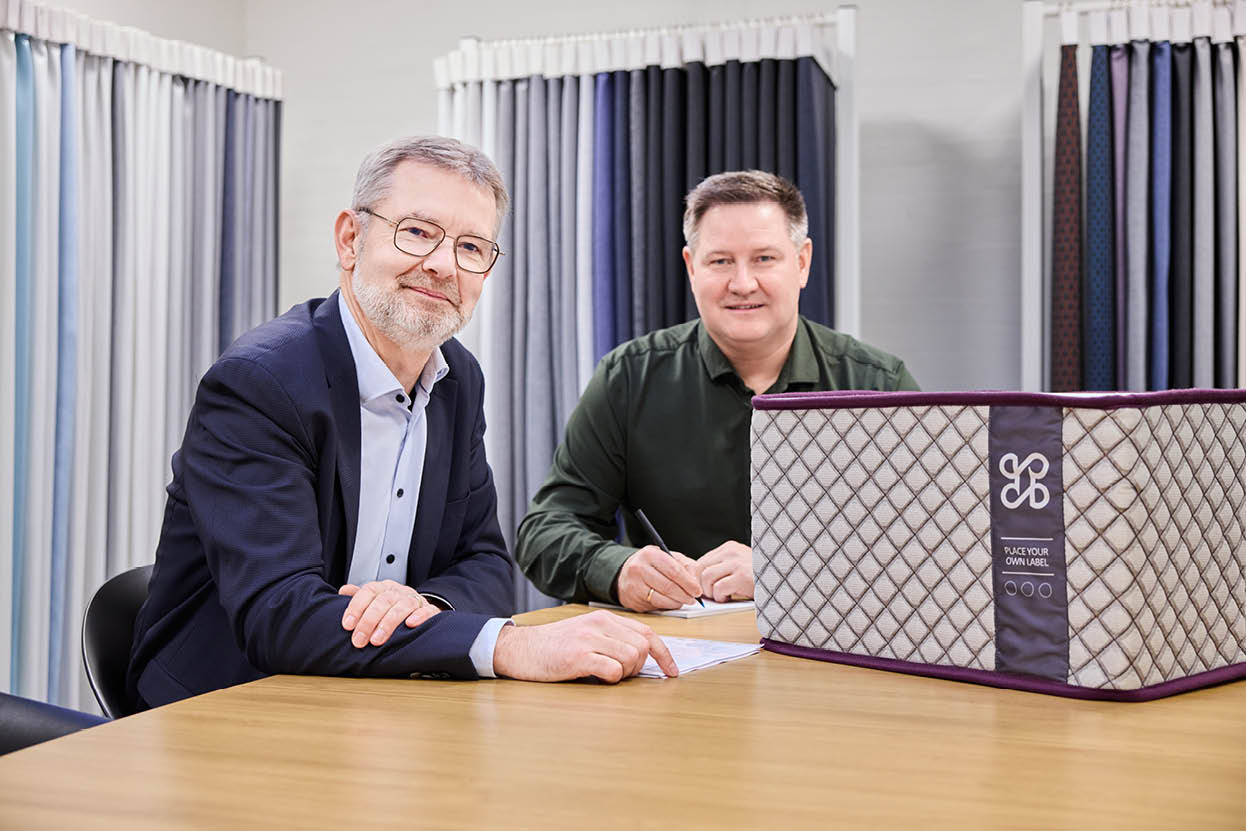
Producing a custom mattress cover can be a complicated and time-consuming process. At Sunds Textiles, it begins in the company showroom, devoted not to finished products but to fabrics and inspiration.
“What we are offering is our expertise, our knowledge, and our equipment, and how to convert that into a product that the client can work with,” says Area Sales Manager Bo Vang. “We listen a lot. We ask a lot of questions, and after that we try to narrow down a little bit into a product or direction that would work for the client.”
Sunds Textiles A/S began in fashion but is now grounded in the sleep industry. Spanning the Atlantic Ocean with its vertical production facilities, Sunds Textiles specializes in stretch mattress ticking and covers, competing in the European and North American markets through quality, customization, and the agility to navigate changing conditions.
“Sunds Textiles was initially a knitting company supplying textiles for the European fashion industry,” says CEO and Managing Director Claus Vang Nielsen. “Expansions in Poland, Ukraine, and Mexico have over the years transformed the company to an international player with full focus on the mattress industry.”

A fashionable start
The origin of Sunds Textiles dates to 1968. In the central Denmark village of Sunds, Vang Nielsen’s father founded a spinoff from another family company known as Vangárd Sportswear. From a few circular-knitting machines, production began to grow, and a dyehouse was added in 1975 for in-house fabric finishing. In 1990, the company began producing ready-made garments with the establishment of a cut-and-sew factory in Poland.
In 2001, the company, known by then as Sunds Velour, made a major step with acquisition of a facility in Ukraine.
By the millennium, global fashion production had largely relocated to Asia, and Sunds started shifting production from velour to double jersey textiles—the preferred fabric of the mattress industry.
A name change to Sunds Textiles in 2011 reflected a strategic shift, as most production transitioned from fashion to bedding. The company leveraged its cut-and-sew expertise in fashion and sports textiles to pioneer pre-sewn mattress covers.
“There are quite a few ticking producers who can supply a mattress cover, but not many have the dedication, experience, and capacity to convert most of their fabric output into covers,” says Vang Nielsen.
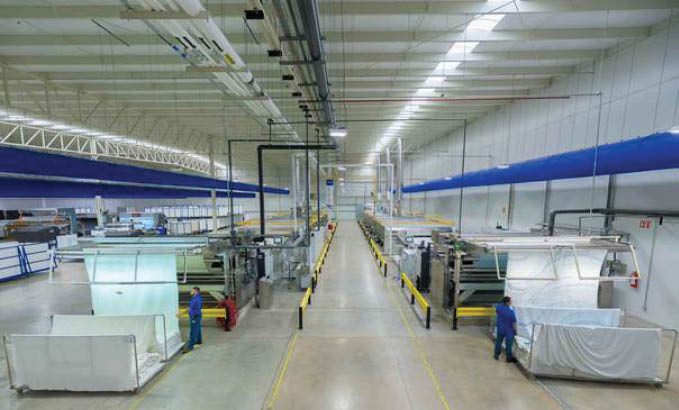
Today, Sunds Textiles primarily produces ready-to-zip mattress and pillow covers. From 4,000 to 6,000 mattress covers and 15,000 to 30,000 pillow covers are produced daily. About 150 state-of-the-art circular knitting machines in a range of diameters and settings, including eight to 10 machines added in 2025, produce high-quality knitted fabrics, including double-knit jacquard ticking, velour, and other single- and double-jersey fabrics.
Finishing lines—now up to six, since the addition of a new one in 2025—perform washing, bleaching, dyeing, printing, and padding. In-house cut, quilt, and sew capabilities produce mattress covers, overlay pads, and pillows.
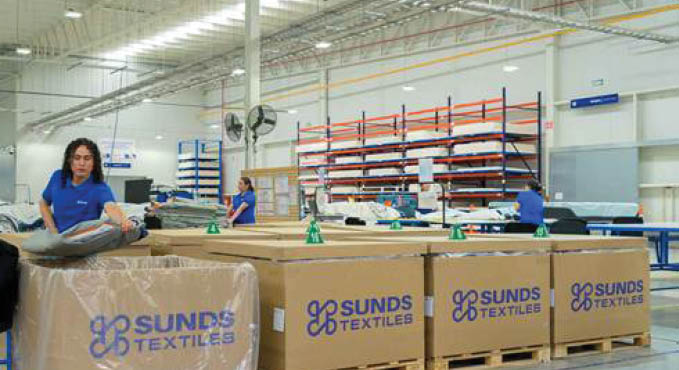
Sunds Textiles began supplying mattress covers to the United States in 2006, and today, the U.S. market accounts for about half of turnover. As that segment blossomed, the company built a plant from the ground up in Mexico, going fully operational in Guadalajara in 2022.
While the 550,000-square-foot Ukraine plant is the company’s largest, the Mexico facility—now at 250,000 square feet—is “growing fast” to continue meeting demand, says Vang Nielsen.
Sparking inspiration
Now in its third generation, Sunds Textiles remains a 100% family-owned business. Vang Nielsen began his career in the family textile dyehouse in Denmark before entering garment production in Poland. He served fashion customers throughout Europe before starting production in Ukraine in 2003 and leading the later addition in Mexico.
Bo Vang, Claus Vang Nielsen’s cousin, worked in a German mattress store and in sportswear before joining Sunds Textiles in 2022.
The Sunds Textiles customization approach “starts with fabric,” says Vang Nielsen. The company creates more than 300 new fabrics a year, adds Vang. In a market where newly created textiles are rare, “that’s a lot,” he notes, but variety is the key to sparking the imagination of clients who don’t always have a clear concept of what they want.
“We develop a lot to create inspiration for the clients,” Vang says. “They may think this small dot we developed would be perfect together with this kind of knitting construction, combined with this finishing on the fabric, and it could be nice if it could have this specific touch to it.”
Sunds Textiles takes seriously its duty to help mattress brands design and develop “the face of their mattress,” says Vang Nielsen. A breadth of resources, supplies, and finishing techniques enables customization and allows Sunds Textiles to empower every client to differentiate. Whether they choose to compete on price, comfort, cooling, sustainability, or other factors, the teams at Sunds Textiles design and make a product that accommodates customers’ unique specifications.
With its vertical production facilities, Sunds Textiles makes about 85% of the fabrics for its covers internally. The remaining materials and components, including all yarns, are sourced from suppliers worldwide. Those yarns are procured from producers making colors and formulations for whatever the market and clients require.
“There are hundreds of possibilities in yarns,” Vang Nielsen says. “We prefer to be flexible to be able to buy nylon from Vietnam as well as cotton from Peru, because we don’t know what will be in fashion next year. We like the flexibility to offer the customer anything that makes sense.”
With its array of highly specialized and diverse equipment, Sunds Textiles also works with all fibers—natural, manmade, or recycled. “We are constantly on the lookout for new, innovative products that could be documented to positively impact sleep quality or environment,” Vang Nielsen says.
As a quiet company that prefers to let clients take the spotlight, Sunds doesn’t share its customers or projects, but it has worked with—and embroidered or printed the names of—recognized players on its covers. They include Nectar, Purple, Sealy, Tempur-Pedic, Awara, Casper, Dunlopillo, Nora, and DreamCloud.
“If you know what to look for, you will find our products in all types of outlets, including Mattress Firm, Amazon, Costco, and many more,” says Vang Nielsen, adding that a “Made in Ukraine” label is one telltale sign of a Sunds Textiles product.
Logistically, it makes sense for Sunds Textiles to supply the U.S. East Coast from Europe and the West Coast from Mexico. Third-party contractors handling logistics provide the flexibility to establish supply chains and warehousing anywhere in the United States—currently in South Carolina and New Mexico, supported by internal warehouses in Denmark and Mexico.
As just-in-time delivery from Asia wanes in popularity, Sunds Textiles is leveraging supplier-managed inventory to help propel growth, Vang Nielsen says. That places products in the vicinity of customers for responsive delivery.
“Our possibility to be closer to our customers means telling them they don’t have to wait three months for a container to arrive,” he says. “Tell us what you think you are going to need, and we’ll put in a warehouse inside the United States so we can supply you within 24 hours.”
‘Open to ideas’
The company culture is devoted to openness and shared contributions. With a somewhat flat hierarchy, only 30 of Sunds Textiles’ 1,000 employees work in Denmark. In all production facilities and at headquarters, employees are encouraged to balance personal responsibility with teamwork. Despite different national cultures, production employees know that they can share their ideas and concerns with management visiting from Denmark.
“The culture is really that I’m open to ideas from anyone,” Vang Nielsen says. “I don’t care where they came from in the organization, and the same goes for the rest of the 30 people in the headquarters.”
And, he added, “we understand that we are no stronger than the weakest link in our operation. Thus, we aim to engage everyone in the continuous process of identifying potential risks, bottlenecks, and opportunities. This clearly means that we have a great deal of respect for all our employees and take the responsibility to treat them accordingly.”
With production on two continents, maintaining consistent quality comes from attention to detail, executives traveling among facilities, and copycat equipment fleets.
“Basically, we control the headlines from Denmark,” says Vang Nielsen. “The raw materials, the yarns are exactly the same, so we can work in several ways to make sure we have the same product.”
The Sunds Textiles Ukraine facility has not lost a day of production since the Russia-Ukraine war started in 2022. Located in western Ukraine, near the Polish border, it has been undisturbed by Russian incursions in the east. But every family in Ukraine has been affected by the war, “and unfortunately, many of them in devastating ways,” says
Vang Nielsen.
In this atmosphere, Ukrainian employees often plead with company officials to “just keep the factory running,” or they say, “We need some normality in our lives, and it helps [to] be able to go to work every day.”
“We do our best to comply with this humble request, but [since] cut-and-sew operations are highly labor-intensive processes, and as we do have seasonal variations as well as market concerns, cut-and-sew capacity is unfortunately not a constant,” Vang Nielsen says. “Thus, we find ourselves constantly either building capacity or having to reduce. We are not the heroes here, but we do of course engage with the local community and authorities to try to help where we can.”
Managing other pockets of geopolitical uncertainty also demands a nimble approach. The entire industry is waiting for some certainty concerning tariffs, Vang Nielsen says, which could arrive with negotiations to end the Russia-Ukraine war and through review of the United States-Mexico-Canada Agreement. No matter the outcomes, Sunds Textiles’ two-continent approach creates “the possibility to move product back and forth, according to whatever makes sense.”
The company intends to continue investing in machinery enterprisewide and hopes to expand in Guadalajara, “although we will probably hold the cards longer before we decide how to play them,” Vang Nielsen says. Investments in solar panels in Ukraine in 2025 helped provide a reliable energy source, and the company continues to update and supplement its Ukrainian machinery “to make sure everything remains top-notch and ready for additional business.”
While customers express satisfaction with Sunds Textiles’ logistics, the possibility of establishing a U.S. footprint remains likely, but any details “have yet to be decided,” says Vang Nielsen.
High standards
In Vang’s time working within the family company, he says he has been astonished by its commitment to quality and high standards, including its meticulous techniques in the knitting department. “I see that when I get out in the market,” he says.
“The quality we offer is very high. It is nice to be there, presenting something you can be proud of.”
Balancing that quality with price is made possible through Sunds Textiles’ commitment to listening, since at times customers need help deciding what they want. “We have to listen a lot and ask questions and make a lot of trials,” says Vang.
Quality is also part of a culture of engagement that instills vigilance among every team member, Vang Nielsen notes. “If you see a mistake in production, the easiest thing is to turn a blind eye instead of going to the boss,” he says. “It takes a lot of teaching before anybody understands that they are also part of making a quality product.”
The Sunds Textiles team works “behind the product” to assure clients the right product at the right price and right quality, while it also meets high industry standards, says Vang. Certifications include Oeko-Tex® STeP (Sustainable Textile and Leather Production) and Oeko-Tex® Standard 100 for textile safety. “Our clients depend [on the fact] that we have done our homework, meaning that we are sure that our products are up to date with standards in the market,” he says.
Looking into the future, Vang Nielsen hopes for peace for the Ukrainian staff, as well as “a more peaceful world, so we can build this into a stronger company and have two equally strong supply bases in Ukraine and Mexico.”
He quotes an automobile industry maxim to sum up how Sunds Textiles thinks about employees and customers: “Coming together is a beginning. Keeping together is progress. Working together is success.”
“If we try to do everything and serve everyone, we will fail our mission, so we must have the courage to say no if we do not feel that we are the right fit,” he says. “We like to understand how we can make a difference. We can’t be everything to everyone, but we can be something to someone—even a lot of someones.”
Sidebar: Another Branch on the Family Tree
In a sense, the Vang Nielsen family tree extends into Mexico, says Claus Vang Nielsen. He spent time as a trainee in a Guadalajara, Mexico, sportswear company “way back in the ’80s” and has maintained relations with the owner and host family, the Prietos, ever since.
When planning for a Sunds Textiles Mexico venture began in 2019, Vang Nielsen already had the connections, and the new-build plant in a Guadalajara industrial park went fully operational in 2022. “The location of the Mexico plant is no coincidence, and a few members of the Prieto family are today associates of the Sunds Textiles Group,” Vang Nielsen says.