
Between rising inflation, tariff scares, a sluggish housing market, and a post-pandemic spending slump, the mattress market has had much to overcome in recent years. Adhesive manufacturers are doing their part to hold things together.
“As mattress industry sales remain soft, controlling costs and protecting margins has never been more important,” says Darren Gilmore, CEO and president of Simalfa. “Our newest innovations are designed to help manufacturers do exactly that. At the same time, higher import costs, labor challenges, and global supply chain uncertainty are driving a stronger focus on efficiency, flexibility, and smarter sourcing.”

Always changing, always innovating
Efficiency and innovation are top of mind these days for people and companies charged with bonding mattress materials—which are, as SABA North America CEO Jim Turner says, always changing.
“There’s a constant stream of new materials added to mattresses; it’s a marketing-driven industry,” Turner says. “More natural fibers, all different foam types, a lot of
changes in foam composition—but that’s normal. As the industry that bonds all this stuff together, we have to know what’s coming.”
To stay abreast of developing improvements, SABA works closely with its customers “to help them be more efficient so they get more mattresses out of each gallon of adhesive.”
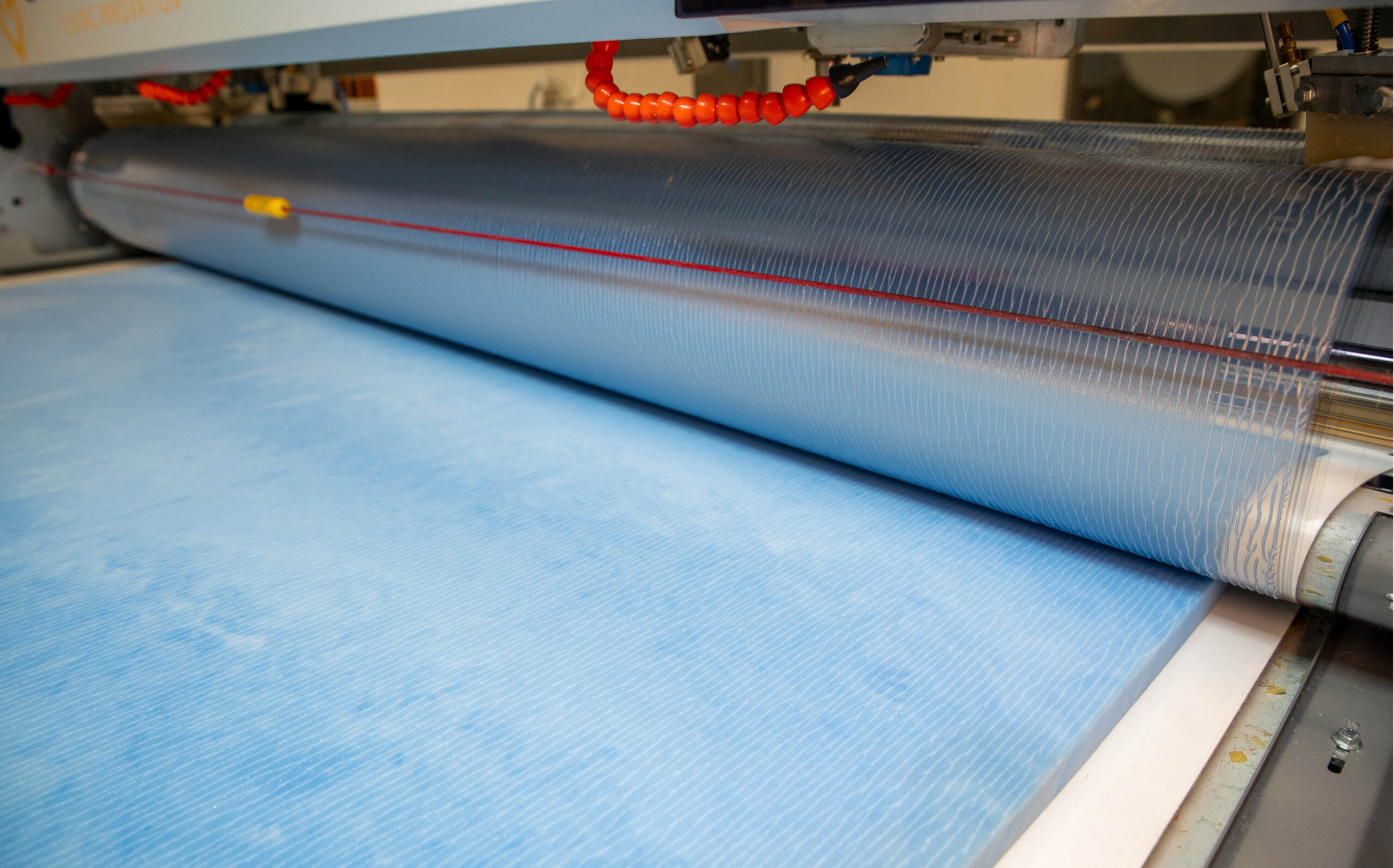
This year, the company is introducing Sababond 3245, a polyurethane-based rollable adhesive that, in addition to being designed with mattress recycling in mind, will allow for a higher-volume mattress output as compared with current water-based bonding technologies.
“High-volume production is generally done with a roll coating system. Most polyurethane adhesive developments in the past have been sprayable, which doesn’t really satisfy the need for high-volume production,” he says. “This is the first of its kind—and very cost-effective.”
The company has also added a full portfolio of hot melt adhesives in recent years, branching out from its traditional focus on water-based adhesives. “Our mission is to be the global leader in sustainable bonding solutions for the mattress industry, and thus adding hot melt was a natural fit,” says Turner.
At Worthen Industries, developers have created a two-component system to dramatically speed up the bonding time of water-based adhesives. “Water-based adhesive has very good adhesion, but the speed of set sometimes can be slow,” says Steve Adams, business manager for Worthen’s foam fabricating adhesives group. “So, what we created is a two-component system that includes a spray bridge activator in the process that dramatically speeds up the adhesive.”
The result is an instant bond—which also works on the bonding of pocketed coils and densified fiber pads—without the loss of water and with a 20% increase in efficiency.

State of the art
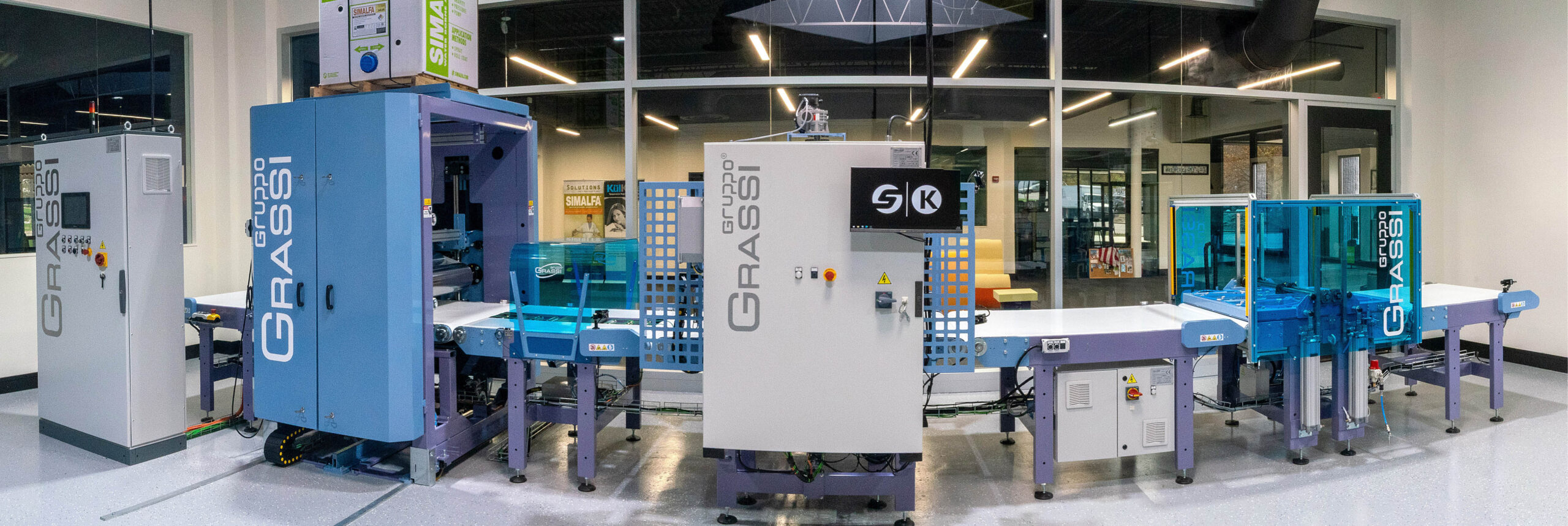
New manufacturing plants and thoughtfully designed headquarters are another sign of innovation at work in the industry. Last September, SABA staff moved into new U.S. headquarters in St. Clair, Michigan. The plant includes a full-size, industrial-scale, automated adhesive application line for both water-based and hot melt. The state-of-the-art technical center has everything needed to produce a mattress from a bonding perspective.
“We made this investment as a resource for the mattress production community. Our customers can now assemble mattresses here and ship them back to their facility for evaluation. It’s also a resource for those evaluating automation to test drive a fully automatic line before investing,” Turner says. “For customers with automation already in place, it’s often challenging to test something new because they can’t get time on their own [equipment].”
Similarly, Simalfa is celebrating one year in its new Oakland, New Jersey, production facility and Innovation Center. This site represents the largest research and development investment in the company’s more than 30-year history and has already proved to be valuable for collaboration with Simalfa clients, significantly strengthening the company’s ability to develop and scale new technologies in close partnership with mattress manufacturers.
Worthen, meanwhile, is addressing another big industrywide challenge with significant facility upgrades: The company has installed solar arrays on three of its four manufacturing facilities, with a total capacity of 2 megawatts. “We calculate that this will avoid more than 800 tons of CO2e emissions,” Adams says.
Solving the sustainability conundrum
Sustainability is an ongoing priority across all areas of the mattress industry, and everyone agrees on its importance. “We can’t keep sending mattresses to the landfill,”
Campitelli says.
To recycle most mattresses, they must be disassembled, which means people in the adhesive industry are charged with a unique problem to solve: Come up with a bonding agent that works exceptionally well during the many years the mattress is being used yet doesn’t make it difficult to separate mattress materials when it’s time for recycling.
“Can we have adhesives that perform very well, and then start degrading at the end of mattress life? That’s a challenge. You’re asking me to provide something that works very well today, and then doesn’t work at all in 10 years,” Campitelli says. “But it’s a challenge we’re trying to figure out.”
Turner agrees. “It’s a huge issue we face as an industry today. It’s at the top of everybody’s list of things to figure out.”
To address the problem, Worthen’s new two-step adhesive process can customize the final bonding strength. “The system can achieve bonds that will give complete and permanent substrate failure or can be adjusted to provide strong bonds that can be peeled apart at end of life for more efficient recycling of the mattress,” Adams says. “It gives you a versatility that wasn’t possible before.”
For Sababond 3245, SABA’s R&D team worked with a major global chemical manufacturer that’s involved in the chemical recycling of foam. The resulting water-based rollable adhesive using polyurethane eliminates the need for debonding at the mattress’s end of life. “There isn’t a need to disassemble or de-bond the mattress if the adhesive composition matches the foam composition,” Turner says. “It’s a major breakthrough.”
SABA also has a new polypropylene hot melt for pocket coil production that supports the same type of mono material design, matching the adhesive to the substrates
being bonded.
Sustainability continues to be a major focus for Simalfa, which—in addition to its own line of sprayable and rollable polyurethane adhesives—offers EcoPeel, a water-based adhesive that delivers reliable in-use performance while allowing mattress components to be separated at the end of life, supporting recycling and circular manufacturing. “This end-of-life focus reflects how Simalfa is aligning adhesive innovation with the long-term sustainability goals of the bedding industry,” Gilmore says, goals that are driven both by brand expectations and consumer demand.
Savaré’s polyethylene mattress adhesives are designed with sustainability in mind as well, with chemical compatibility and being up to 100% bio-based. “So, they’re not considered a contaminant at all and can be recycled in the same process,” Campitelli says.
Challenging times
The industry has had its share of challenges in recent years—including slumping sales due to inflation, a sluggish housing market, and a post-COVID-19 downturn in demand. In addition, 2025’s tariff-related threats, unexpected costs, and ensuing uncertainty generated even more issues to overcome.
“Tariffs have impacted everybody on the water-based adhesives side,” Turner says. The primary raw material in most water-based adhesives is dispersed polychloroprene, which is not produced in the United States. It’s produced in Europe and Asia, which faced pressure from the tariffs that then reverberated back to U.S. businesses. “We are paying higher import fees, which certainly created cost challenges for us as suppliers—and for the market,” he adds.
SABA’s response has been to work closely with its customers to find ways for the production process to be more efficient with the adhesives they use, “so they get more mattresses out of each gallon of adhesive.” Another tactic it is employing is the “good, better, best” scaling of its adhesives, offering a lower-priced alternative for each of its core products. “It allows the customer to choose from a menu of options,” Turner says.
Worthen felt—and addressed—a similar pinch in the supply chain. “I’d say the biggest challenge has been to shore up the alternate sourcing, not only with alternate suppliers but to make sure that geographically you have alternate sourcing,” Adams says. “So, you’re not just stuck with material from one region of the world, for example.”
Worthen typically sources materials domestically and internationally, but it recently introduced a water-based adhesive that is entirely sourced and produced domestically, cutting out the threat of increased costs due to tariffs. It has also introduced products that are acrylic-based rather than polychloroprene-based, because the acrylic-based materials are more easily sourced domestically.
Simalfa’s newest innovations are also designed to help manufacturers control costs and protect their profit margins. That includes products such as Simalfa 981-PU and Simalfa 875-SGT (Smart Glue Technology), along with continued advancements in KulKote Temperature Regulating Technology.
“With a broad range of water-based chemistries—including chloroprene rubber, polyurethane, and acrylic systems—we help producers choose the right solution for their materials, processes, and performance goals,” Gilmore says.
Driving toward greater efficiency and diversification has helped the most nimble companies weather the rough seas of a soft market, but Campitelli says it’s been difficult to lose many of the industry’s long-standing mattress companies in recent years.
“The biggest challenge is seeing a lot of family-owned companies not making it anymore,” he says. “We are losing a lot of know-how, a lot of historic presence in the market, people who built the mattress market in the U.S. So, the challenge is this consolidation. Everyone’s in survival mode.”
Industry projections for 2026 are more positive, with sales hopefully heading in the right direction. Glue makers are eager to contribute to the upturn, thanks to their diversified sourcing and efficiency-driven innovations.
“If the industry projections are correct and the sun is about to come out,” Turner says, “we’re all ready, suppliers and mattress producers, to ride the wave of growth.”