
Whether it’s called “source reduction,” “waste prevention,” or simply “efficiency,” manufacturers have been finding ways to use materials more efficiently and prevent waste for years.
Manufacturers, regardless of the industry, inherently look for efficient ways to manufacture, because wasted material equals wasted money. Layered on top of that is the desire to do good by preserving resources and causing the least harm to the environment.
What’s different today is the need to quantify all that work and to find ways to do it even better. “Many manufacturers are already implementing source reduction, even if they don’t call it that,” says Justine Fallon, vice president of operations at the Mattress Recycling Council, a nonprofit created by the International Sleep Products Association. “There is an opportunity to identify those efforts, measure their impact, and help us understand what is working across the industry.”
“Source reduction is getting somewhat of a resurgence in the U.S. after decades of concentrating on recycling efforts,” adds Alison Keane, president of ISPA and MRC. “Since the China Sword—or Operation National Sword, which banned the import of 24 categories of solid waste—the U.S. has tried to modernize its recycling infrastructure to reshore all the waste that was sent overseas to be recycled. Now, with packaging [extended producer responsibility] shining a light on all the material that cannot easily be recycled and still has little to no recycling infrastructure here or elsewhere, source reduction is playing a bigger role.
“Thus, using less material or more recyclable materials and using more reusable packaging is being driven by packaging EPR laws and bleeding over to other EPR programs, such as mattresses.”
Definitions matter
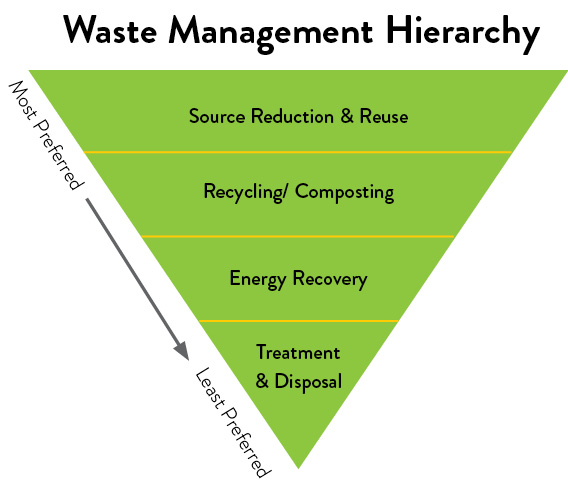
The U.S. Environmental Protection Agency identifies source reduction as the most environmentally preferred strategy for reducing waste. In fact, source reduction and reuse are the top level of the inverted triangle that defines the preferred methods of managing materials and waste streams, also known as the waste management hierarchy, as developed by the EPA.
“It can take many different forms, including reusing or donating items, buying in bulk, reducing packaging, redesigning products, and reducing toxicity,” says the EPA. “Source reduction also is important in manufacturing. Lightweighting of packaging, reuse, and remanufacturing are all becoming more popular business trends.”
However, as straightforward as the practice might seem, across all 50 states and within agencies of the federal government such as the U.S. Department of Energy and the EPA, definitions for source reduction and other waste-management practices vary. That variance matters, since certain state-level source-reduction incentives and some federal programs for advanced energy projects are tied to how source reduction is quantified.
Keane believes the definition in general is broader than many people might think. In practice, everything in the inverted triangle above disposal could be considered source reduction. “Generally speaking, if it is collected for recycling, recovery, or disposal, it generally doesn’t get the credit for source reduction because you’ve already created the waste and now you have to do something with it,” she says. “However, if you use it for recovery or recycle it, you’re creating source reduction for the downstream user. So, I really think source reduction is everything up until disposal, but I’d have to argue with the regulators about that.”
Chemical or advanced recycling adds another wrinkle. Plastic film is tough when it comes to mechanical recycling—you need a lot, and managing large quantities of thin, flyaway plastic is challenging—but advanced recycling can turn that plastic back into energy or chemically recycle it down to its monomers and create a new product. “That should be source reduction because it would be displacing virgin petroleum products,” says Keane. “So, it’s all intertwined. And while the definitions don’t really account for the overlapping of all this right now, in the end, if it reduces waste to disposal, we feel we should be getting credit for that.”
Beyond sustainability
Here’s another nuance of that definition worth debating: While source reduction often gets pigeonholed as a sustainability initiative, it goes beyond that. “It really is about operational excellence,” says Keane.
The benefits range from cost savings to improving efficiency, to strengthening compliance, to making supply chains more resilient to outside pressures. When companies recycle, materials are put back in use, which reduces the environmental and operational costs to source the virgin materials needed to make new goods. Turning waste into energy helps displace the environmental impact of burning nonrenewable fuels.
Manufacturers paying attention to source reduction can bolster their environmental and regulatory compliance and emphasize strategic cost-saving business practices. Any industrial or consumer waste that can be used or remanufactured provides source reduction for the downstream user and creates another link in the supply chain.
“I think what gets lost in the strict definition of source reduction is the downstream implications,” says Keane.
How ISPA can help
With packaging legislation placing an even greater focus on source reduction, manufacturers continue to devise ways to reduce waste. ISPA and MRC offer several resources to support manufacturers in this task.
For California manufacturers, MRC’s Sleep Products Sustainability Program, or SP2, is a facility certification designed to help companies establish an environmental management system that identifies opportunities to reduce negative environmental impacts, improve operational efficiency, implement best practices, and measure progress over time. While SP2 aligns with many of the principles of the ISO 14001 certification, the international standard for environmental management systems, it is intentionally designed for the unique needs of the mattress industry and focuses on practical, continuous improvement.
“The focus is on waste,” says Fallon. “They look at the waste generated throughout the production process, from quilting to fabrication, to identify opportunities for waste prevention, process improvements, and greater efficiency. So, while it’s a facility certification, it gets into the materials and processes behind each product coming out of that facility.”
Beyond helping manufacturers avoid negative effects on the environment, SP2 also helps them identify opportunities to improve operations, reduce costs associated with waste, engage employees in sustainability efforts, and create measurable goals for continuous improvement. By taking a systematic approach to evaluating manufacturing processes, companies can make sustainability a part of everyday operations rather than a separate initiative.
Players from the full length of the mattress value chain—suppliers, designers, manufacturers, and recyclers—can mark their calendars for the ISPA Sustainability Conference, which is held every September. The first day of the conference features a workgroup on circular design, during which all members of the mattress value chain sit at a table to discuss real issues they’re facing and figure out solutions together. Waste reduction is a hot topic during the workgroup’s Design for Disassembly, Circular Fabrication Materials, and Packaging Across the Value Chain breakout sessions.
During day two of the conference, presentations cover options for waste reduction and reuse. Past examples include a session on LiquiDonate, which routes unsellable returns (such as comfort returns) to nonprofits, lowering supply chain costs and helping companies reach zero waste, or a program by Simba Sleep and The Furniture Recycling Group that addresses comfort returns through a Simba-certified refurbished-mattress category.
According to Keane, MRC invests $1 million in research every year, much of that going to foam and textiles research, as those materials are more difficult to recycle than the metal and wood in mattresses. Thus, the idea to create foam and textile workgroups originated with ISPA’s Sustainability Committee, whose members represent expertise from across the mattress value chain.
Recognizing the need for greater collaboration on these complex material streams, the committee proposed dedicated workgroups to bring together manufacturers, suppliers, recyclers, researchers, and other stakeholders in a pre-competitive environment. Today, MRC facilitates these workgroups, leveraging participants’ collective knowledge and experience to strengthen research, identify emerging challenges, generate new ideas, and help accelerate practical solutions and technologies that improve the recovery and recycling of post-consumer mattress foam and textiles.
Keane further sees an opportunity for the mattress industry to collaborate with the textile, apparel, and footwear industries on how best to recycle items like toppers. “If we can figure it out together, then we’re going to be in much better shape than each sector trying to figure it out by themselves,” she says.
Meanwhile, although much of today’s discussion around source reduction is being driven by new laws around disposable packaging, as a product, mattresses are clearly not in the same category. “I think it’s important to say that a mattress is a durable product,” says Fallon. “This is not a product that you throw away once a week or put in your recycling bin. This is a durable product that is built to last.”
Extending a product’s lifespan—coupled with reuse and renovation—then becomes a key component of source reduction. MRC educates consumers through an active, ongoing effort promoting proper mattress care to prolong its useful life and delay replacement. “This effort is centered on mattress care information featured on ByeByeMattress.com/mattress-care, which is accompanied by an eight-part social media campaign that provides simple care tips—such as periodically rotating a mattress and vacuuming it—and refers consumers back to the website for additional tips,”
says Fallon.
Adds Keane, “In the packaging EPR laws, if the packaging is reusable for five years, it is not subject to the regulations—it is exempt. Yet we are now being asked about our source-reduction activities. However, we are happy to tell our story, as we have incorporated source reduction since the beginning of the MRC program. It is not only integral to our product—it is part of our association’s culture.”
Resources
Consumer education to extend the life of a mattress: ByeByeMattress.com/mattress-care.
Foam and textiles workgroups: For more information or to join, contact Kate Caddy at [email protected].
ISPA Sustainability Conference: The annual two-day conference features the Industry Workgroup on Circular Design and a schedule packed with practical sessions, so attendees leave with actionable plans. Learn more at ISPASustainability.com.
MRC’s Sleep Products Sustainability Program (SP2): California manufacturers are encouraged to pursue this certification. Manufacturers in other states can learn best practice tips and more through the free resources available at MattressRecyclingCouncil.org/SP2. MRC also offers a series of best practices videos on its YouTube channel, @mattressrecycling.
For more ways ISPA can help with source reduction, contact Kate Caddy at [email protected].
Talk to Us
What source-reduction strategies has your company implemented? We’d love to hear your stories—and publish them in an upcoming issue. For example:
- Do your suppliers offer bulk packaging or returnable/reusable container programs?
- How are you reducing offcuts and scrap?
- How have you incorporated product redesign to reduce waste?
- How are you using recycled materials?
Send your stories to Kate Caddy at [email protected].