Sustainability has become one of the defining business imperatives of the modern mattress industry. From recycled materials and certified foams to modular designs and end-of-life solutions, manufacturers are investing heavily in reducing environmental impact. Yet as important as these operational changes are, they are only part of the equation.
Increasingly, success hinges on how effectively mattress manufacturers communicate those sustainability efforts to retailers and, ultimately, to consumers.
Today, that communication challenge is critical. Consumers are more curious, more skeptical, and more informed than ever before. Retailers, meanwhile, must balance consumer expectations with business realities. This means they need clear, credible, and practical sustainability information from their supplier partners.
“The most effective sustainability communication is specific, accurate, and meaningful,” says Scot Case, former vice president of corporate social responsibility and sustainability at the National Retail Federation and executive director of the Center for Retail Sustainability. “It provides consumers with precise, independently validated information along with traditional price, performance, and availability considerations ahead of making a purchase.”
At its core, sustainability communication within the mattress industry isn’t simply about checking boxes or displaying logos. It’s about translating complex environmental initiatives into tangible benefits that resonate with both retail buyers and consumers—and making sustainability a credible part of the product’s overall value proposition.
What consumers want
Consumer expectations around sustainability are no longer abstract or niche. They’re measurable, widespread, and directly influencing purchasing decisions.
According to Suzanne Shelton, senior partner at sustainability marketing group ERM Shelton, consumers are increasingly holding brands accountable. “Seventy-six percent of consumers globally, and 61% in the U.S., hold companies strongly or very strongly responsible for making changes to their business practices to positively impact the environment,” Shelton says. “And 73% of people in the U.S. say that companies that make a product and companies that make a package are somewhat to very much responsible for proper disposal at the end of its life. Only 16% think manufacturers are doing a good job with that.”
At the same time, Shelton notes, sustainability alone isn’t enough to drive a purchase decision. Consumers expect sustainability to coexist with performance, value, and safety.
“They generally will not make trade-offs for sustainability,” she explains. “What they want is a four-pronged value proposition: better performance, lower price, reduction of chemicals, and elimination of waste.”
This dynamic has major implications for mattress manufacturers and their communication efforts. Sustainability messaging cannot exist in isolation. It must reinforce—not compete with—core product benefits such as comfort, durability, and value.
Clarity, credibility, and certifications
Arin Schultz, chief growth officer at Naturepedic, agrees that when it comes to sharing sustainability messages alongside other product benefits, clarity and credibility are essential.
“The current state of sustainability communication often involves speaking in broad strokes, such as claiming to be a ‘sustainable mattress company,’ without providing specific qualifiers or proof to back up the claims,” Schultz says. “This lack of transparency can lead to greenwashing. We maintain a policy of openness, frequently inviting customers and media to tour our facilities to demonstrate how mattresses are made.”
Naturepedic also sends regular emails to retailers, informing them of any operational changes that impact the environment. In addition, the company sends an annual sustainability report to retailers and customers. These practices create transparency that reinforces credibility and gives retailers concrete proof points to share with customers.
Effective sustainability communication acknowledges both progress and ongoing challenges, says BEDGEAR founder and CEO Eugene Alletto. “We’re not perfect, and we don’t claim to have all the answers. Sustainability is a journey, and we’re very open about where we are in that process.” This honesty builds trust and strengthens brand credibility on both the retailer and consumer fronts.
As manufacturers shift toward more precise, evidence-based communication strategies, traceability systems, certifications, and independently verified standards have also become central tools for building trust with retailers and consumers.
Dan Dobratz, executive director of CertiPUR-US®, says consumer awareness around certifications is growing rapidly. “Consumers are becoming savvier about sustainability and want to know what is in the products they purchase,” he says.
Based on a CertiPUR-US report on mattress shoppers, price and comfort take priority among consumers. But the ability to check CertiPUR-US’s directory or mobile app to confirm a particular mattress brand is using CertiPUR-US certified foam can bolster purchase decisions and help retailers make consumers feel good about their purchase.
“It’s a powerful talking point and a way to leverage certified foam into sales,” Dobratz says.
Equally important, he says, is the rigor behind certification systems. “What makes the CertiPUR-US foam certification program so trusted and so unique among certification programs is our system of checks and balances,” he explains. “Foams have to be certified twice in the first year and annually thereafter. Every year we conduct independent verification audits, and we randomly test about one-third of participating foam producers annually.”
In another example, Naturepedic relies heavily on certifications such as the Global Organic Textile Standard to validate its organic cotton sourcing. “The GOTS certification process requires us to trace cotton from the seed to its arrival at the factory,” Schultz says.
Such verification mechanisms help retailers and consumers distinguish meaningful sustainability claims from marketing language.
“The most significant change any product manufacturer makes is defining and prioritizing
their sustainability goals. With clear goals, the company can then reexamine its product designs, the materials used, the manufacturing process, and how products are marketed.”—Scot Case, formerly of Center
for Retail Sustainability
Retailers as the communication bridge
While manufacturers initiate sustainability efforts, retailers serve as the essential link between those efforts and consumers’ inherent understanding of them.
“Retailers play a critical role,” Shelton says. “Sustainability specifics should be visible alongside other benefits at point of sale. And retailers should be including sustainability content in their organic social media feeds at appropriate times.”
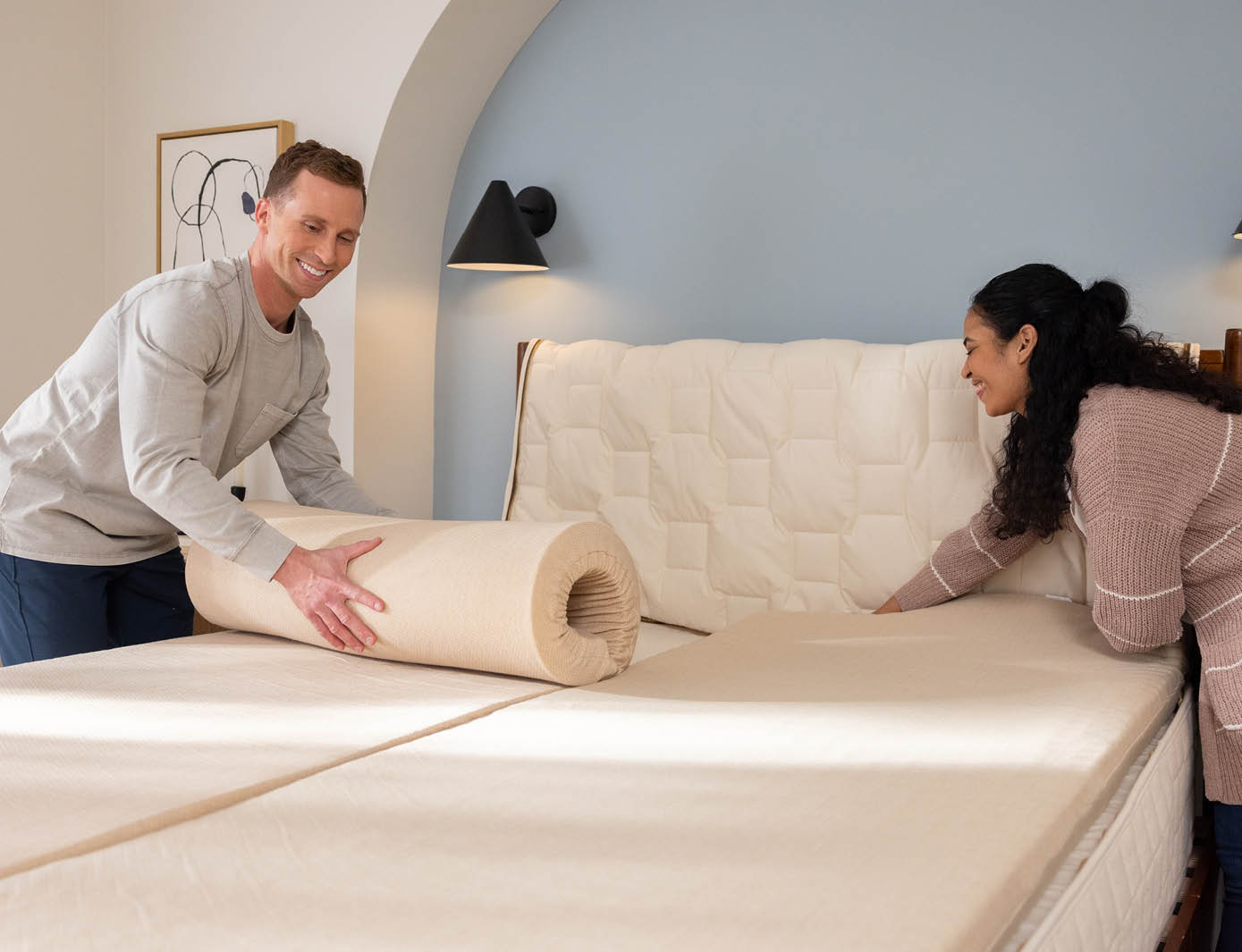
experience with interchangeable layers.
Retail sales associates, in particular, are often the primary interpreters of sustainability information. To support that role, CertiPUR-US developed a free online course that helps retail staff confidently explain certification criteria and address common consumer questions. “Retailers and their sales associates have a tremendous opportunity to inform consumers,” Dobratz says.
Case emphasizes that manufacturers must also tailor sustainability communications to align with retailer priorities. “Ask retailers about their corporate sustainability priorities and for information about their customers’ sustainability interests,” he says. “Outline how your sustainability efforts can help retailers meet their corporate sustainability goals and how your products can meet the sustainability demands of their customers.”
Manufacturers that proactively support retail education through training, materials, and clear messaging are more likely to gain retail support and space within those retail environments. “[That’s why] the most important thing to do is train the people sitting across the desk from retailers during buying meetings,” Shelton adds.
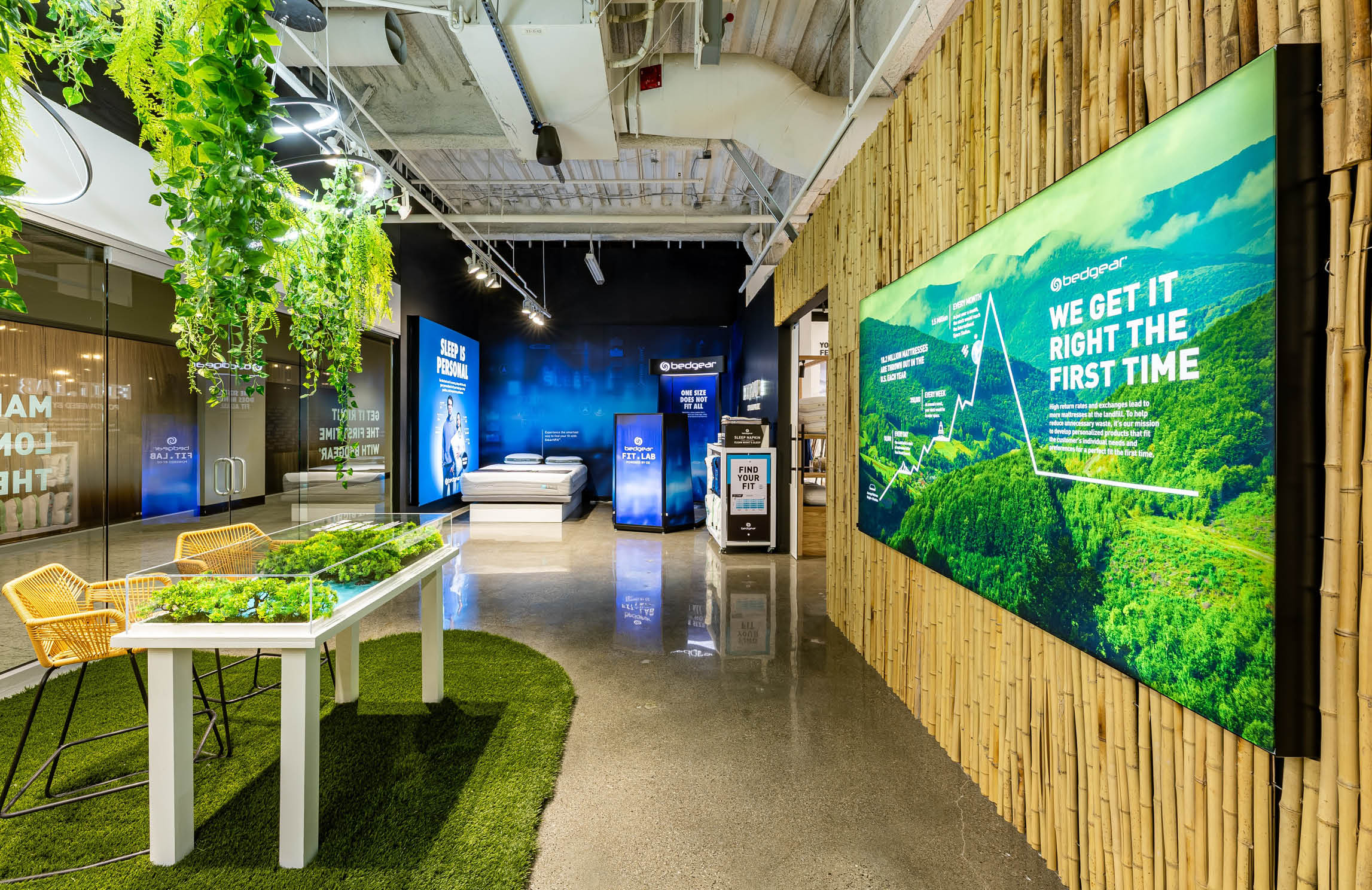
Indeed, leading mattress manufacturers are finding creative ways to translate sustainability initiatives into concrete, relatable retail narratives. BEDGEAR, for example, emphasizes personal fit and modular design as core sustainability features that retailers need to communicate to their customers.
“The industry is talking about sustainability more than ever, and that’s progress,” says Alletto. “But the biggest gap is still behavior. Most of the conversation focuses on what a product is made of, not what happens after it’s purchased.”
High return rates represent a major environmental and financial challenge in the mattress industry. It is estimated that more than 18 million mattresses are discarded annually in the United States, many due to poor fit or comfort mismatch. “At BEDGEAR, we believe sustainability starts by getting it right the first time,” Alletto says. “When you engineer products for personal fit based on body type, sleep position, and temperature preference, you lower the chance of returns. Fewer returns mean less waste, fewer emissions, and fewer products in landfills.”
BEDGEAR reinforces this message with tangible examples that retailers can tap into when working with a consumer. “We highlight that up to 100% of our pillow fill is recycled and that each pillow upcycles 35 bottles,” Alletto says. These concrete metrics help retailers and consumers understand sustainability not as an abstract concept, but as a measurable benefit.
Naturepedic similarly emphasizes operational metrics that resonate with retailers and, ultimately, with consumers. “The low return rate is a significant selling point for retailers because it means fewer returned orders, providing both an environmental story and favorable business metrics,” Schultz says.
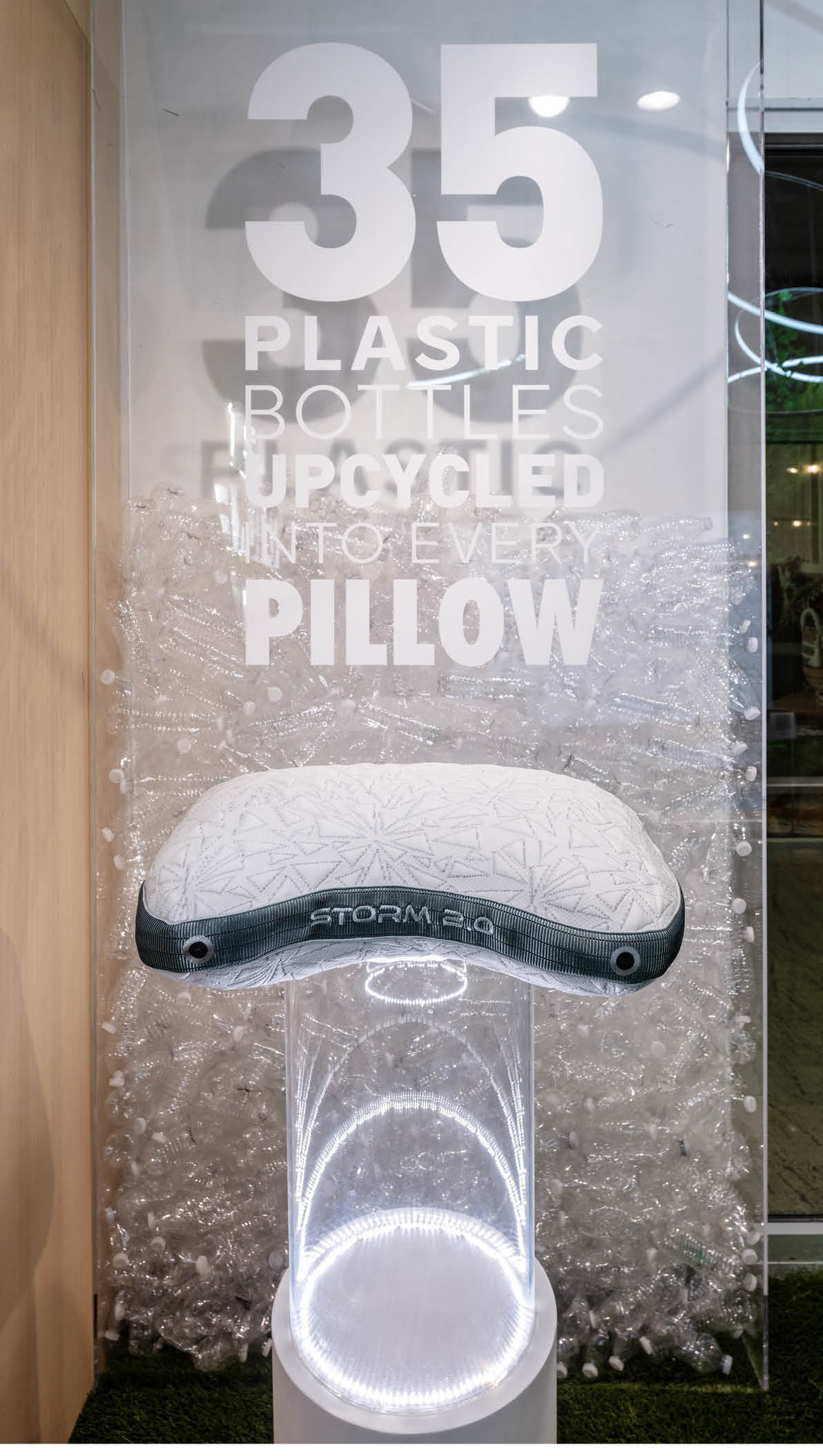
consumers listen, says BEDGEAR, which highlights upcycled
materials in its pillows.
Perhaps the most significant shift in sustainability communication is the integration of sustainability into product design itself. “The most significant change any product manufacturer makes is defining and prioritizing their sustainability goals,” Case says. “With clear goals, the company can then reexamine its product designs, the materials used, the manufacturing process, and how products are marketed.”
BEDGEAR has embraced this approach by prioritizing recycled materials and modular product architectures and clearly communicating these benefits to retailers and consumers. “We prioritize sourcing recycled materials whenever possible and focus on reducing our reliance on virgin resources,” Alletto says. “Across our operations, we’re continually finding ways to keep materials in circulation, minimize waste, and divert significant volumes from landfills each year.”
Naturepedic, meanwhile, also uses innovative packaging solutions such as RollCraft paper to reduce plastic waste. These design innovations serve dual purposes: improving environmental outcomes while creating compelling sustainability narratives for retail partners and consumers.
The competitive advantage of effective communication
For manufacturers, effective sustainability communication offers a significant competitive advantage, particularly in retail environments.
“Sustainability can be a tiebreaker and tip the scales in their favor,” Shelton says. Manufacturers are increasingly equipping sales teams with detailed sustainability information, including pitch decks, leave-behind materials, and training programs.
Naturepedic, for example, communicates sustainability efforts through structured retail presentations that highlight both environmental and operational benefits. BEDGEAR brings sustainability stories to life through interactive retail displays and educational programs that train RSAs on real numbers, certifications, and product-level talking points that they can easily communicate.
These strategies help retailers confidently communicate sustainability benefits to consumers. “When a retail associate explains that each pillow uses recycled materials, that modular components extend mattress life, or that personal fit reduces landfill waste, it creates clarity,” Alletto says. “Education is what turns sustainability from a label into a decision.”
Of course, emerging technologies, particularly artificial intelligence, are poised to reshape sustainability communication.
“A major development to watch is the emergence of AI agents that can assist consumers more directly in their decision-making,” Case says. “These systems may highlight environmentally responsible options even when a user hasn’t specified every detail.”
This evolution raises the stakes for accurate sustainability information, Case adds. “This makes it increasingly important for companies to provide clear, accurate, and detailed product information so AI agents can surface recommendations that genuinely reflect consumer priorities.”
Manufacturers that fail to provide transparent sustainability data risk being excluded from future AI-driven purchasing recommendations.
AI influence aside, as sustainability becomes a core expectation rather than a niche feature, communication strategies must evolve accordingly. Consumers increasingly expect brands to address the entire product life cycle—from material sourcing to disposal. “They want proof, traceability, and life-cycle thinking,” Alletto says. “They expect brands to address carbon emissions, packaging waste, material sourcing, and end-of-life solutions.”
That’s why more manufacturers are responding with holistic sustainability strategies that integrate product design, certification, education, and transparency.
Naturepedic’s partnerships with sustainability-focused retail initiatives such as GreenRow by Williams-Sonoma demonstrate how sustainability alignment can expand market reach. BEDGEAR’s focus on modularity and fit illustrates how product design itself can serve as a sustainability solution. And certification programs such as CertiPUR-US provide independent verification that strengthens consumer trust. Together, these efforts represent a broader shift toward comprehensive sustainability communication.
Ultimately, sustainability communication with retailers and consumers isn’t just about environmental responsibility. It’s about business performance, brand trust, and long-term industry viability. Mattress manufacturers that effectively communicate sustainability gain competitive advantages in retail partnerships, consumer trust, and market differentiation.
As Case puts it, “Manufacturers, consumers, and retailers have access to more information than ever.” The companies that succeed will be those that turn that information into clear, credible, and compelling sustainability stories that demonstrate not only environmental responsibility, but also meaningful value for retailers, consumers, and the future of the mattress industry.
Short and Sweet
Naturepedic’s Arin Schultz stresses that sustainability messaging must remain accessible and easy to understand. “Sustainability messaging to consumers should be kept short and concise,” he says. “Instead of focusing on every chemical or problem, highlight what is not in the products and how making changes now can still have a positive impact on health and safety.”
Focusing on key issues, such as chemical safety and waste reduction, resonates most strongly with consumers, agrees ERM Shelton’s Suzanne Shelton. “People buy greener products because they’re concerned about a product’s impact on their health and their family’s health and because they want to protect natural resources,” she says.