
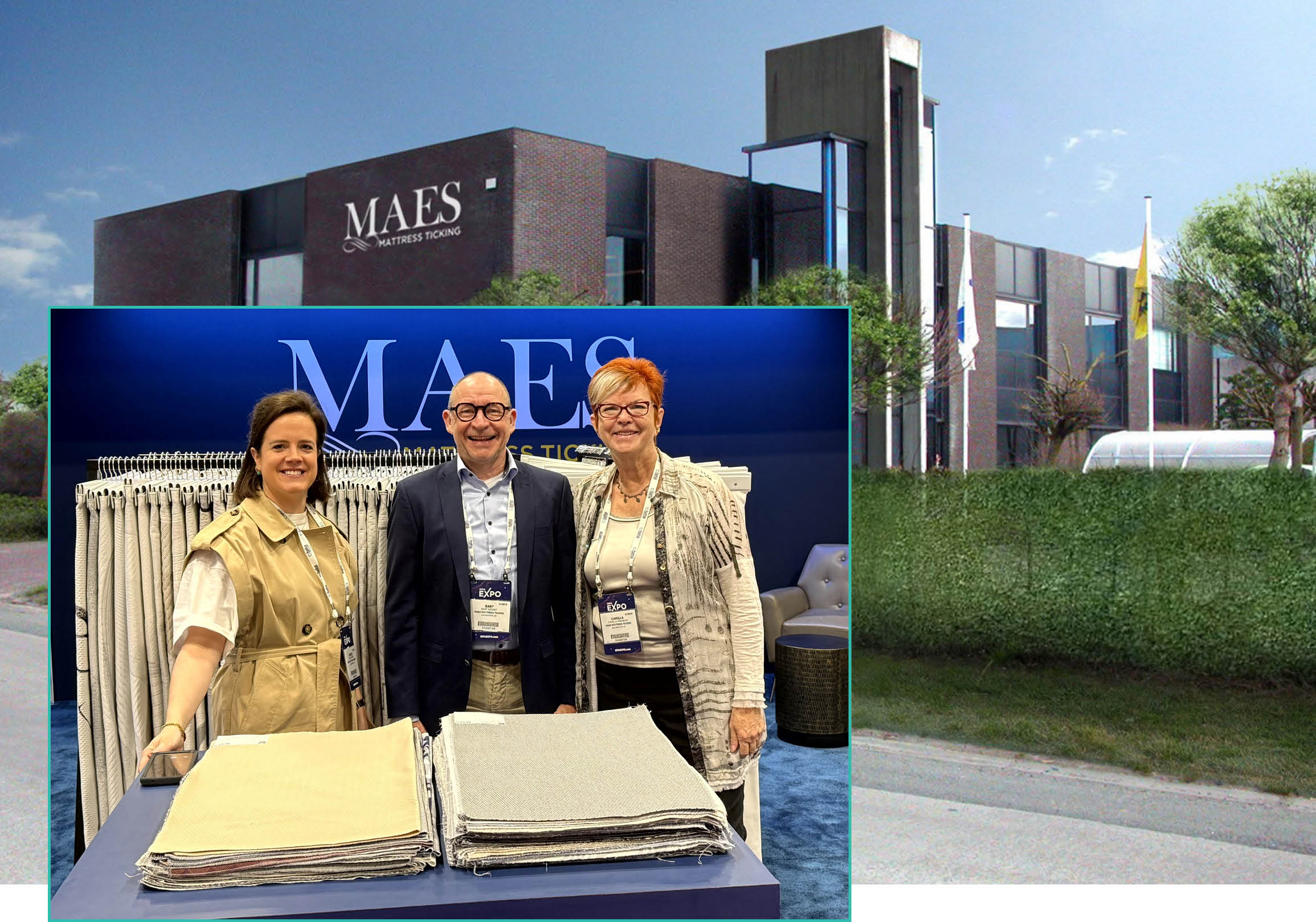
Ticking’s value should never be underestimated. In the showroom, it’s the first thing a buyer sees and touches, while online, it is the only visual clue to a mattress’s quality and comfort.
More importantly, ticking influences comfort, temperature regulation, hygiene, mattress structure, and breathability. And this durable outer fabric continues to evolve. As seen at the International Sleep Products Association EXPO 2026, manufacturers are exploring colors and patterns, fabrics, functional benefits, and even wellness solutions to expand and redefine ticking’s role.
Color changes
While white continues to be a standard ticking fabric color, designers and makers in the United States and Canada in recent years have embraced more color and bold designs. That trend may be softening.
Camilla Franklin, vice president of sales at Maes Mattress Ticking, has seen a strong move toward products that reflect a “home as retreat” aesthetic. When it comes to color, that typically means more natural palettes. “There’s still color,” Franklin says, “but it’s pops of warm color here and there.”
Lindsay Creighton, vice president of sales at Global Textile Alliance USA, expressed there is a growing shift away from overstimulation. “Balanced neutrals create a serene atmosphere that encourages self-reconnection,” she says. “People are increasingly seeking warmth and comfort in their interiors, which is reflected in floral motifs and soft geometric patterns in muted color palettes.”
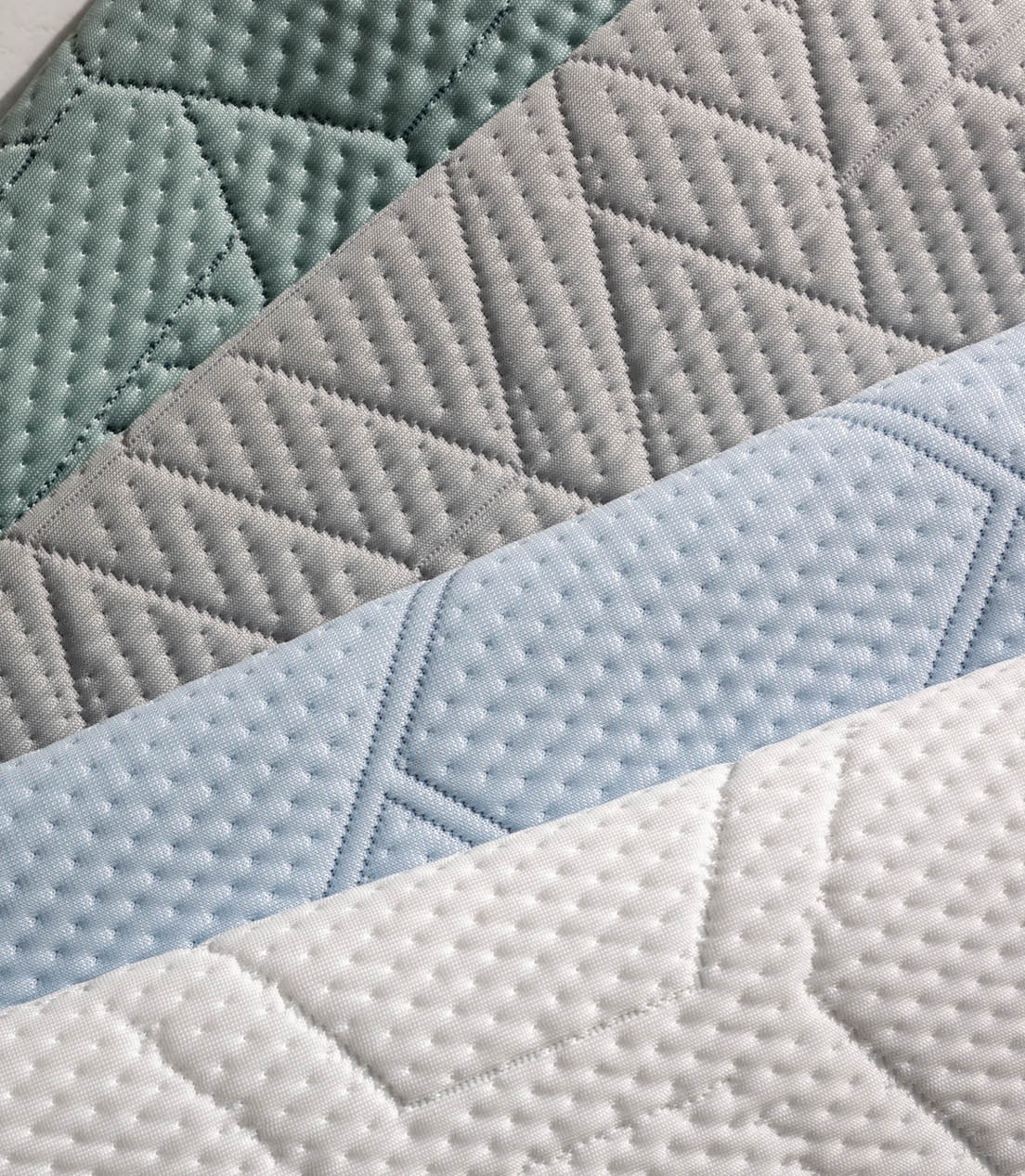
Johan Cleyman, CEO of Innofa Group, who noticed this trend at ISPA EXPO in March, describes it as a move toward more contemporary, minimalistic designs. He believes this aesthetic is being inspired, at least in part, by European preferences. “Europe has been going in a different direction—smaller designs in general, less explicit patterns. European mattresses are way more white, muted, with subtler designs using grays and blues.”
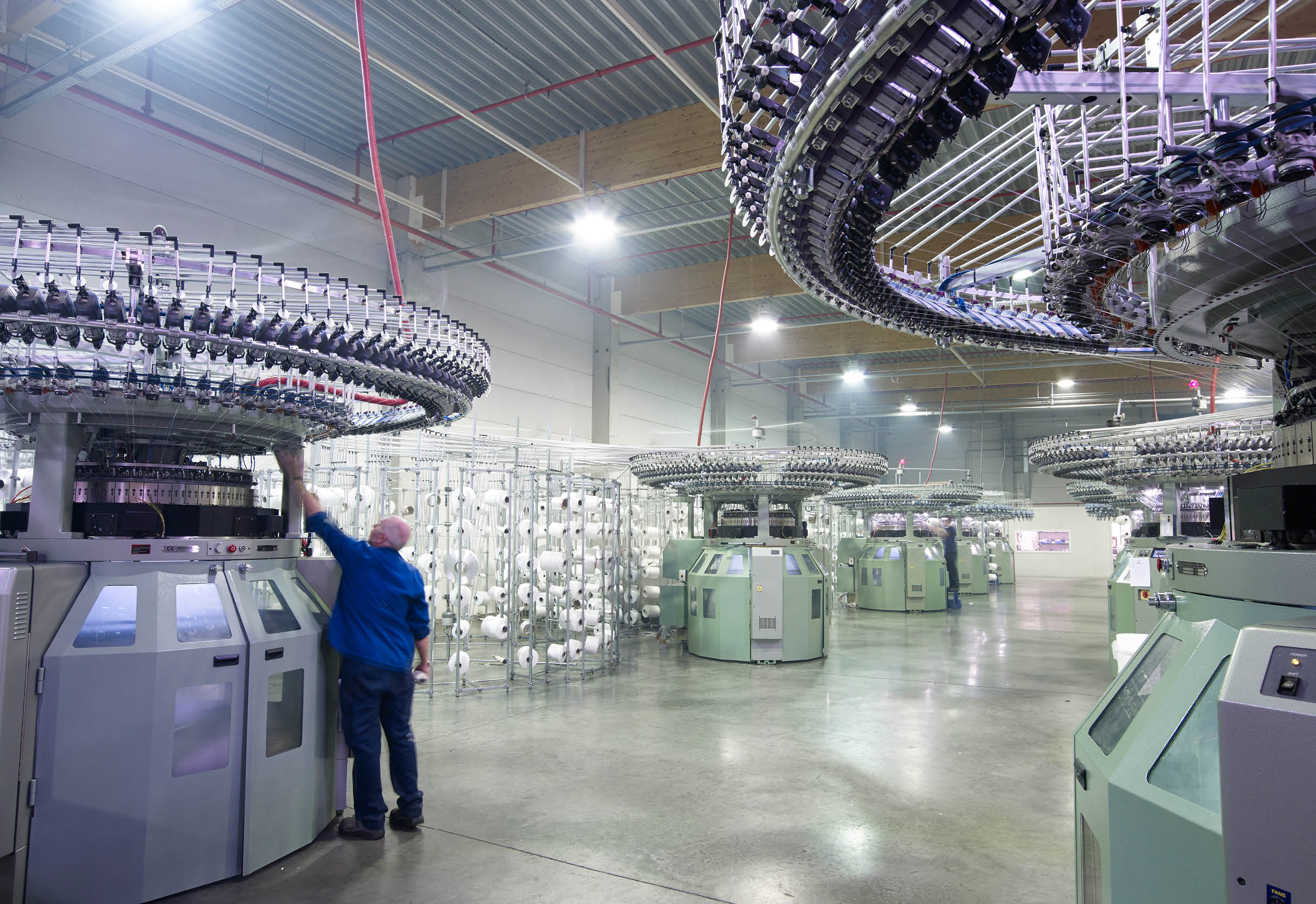
The rise of online mattress sales may have had an influence on color and pattern trends as well. “I definitely think the direct-to-consumer, e-commerce mattress business—which started around 2014 with Casper, Tuft & Needle, Leesa, and so on—has had an influence,” Cleyman adds. “Those designs were traditionally also much more minimalistic. As their market share has grown, so has their impact.”
Look, don’t touch
Still, with online sales representing roughly 25% of the total mattress market, ticking choices must convey a strong message to consumers.
“You have to have a design that is appealing to the customer,” Cleyman says. “In the sea of white mattresses … you want to stand out without repelling potential customers. You want to grab their attention, but not be so bold that they think, ‘I’m not going to be able to get sheets over this mattress that will go with the bold design or the colors.’ ”
During ISPA EXPO, Maes launched a range of fabrics with a unique quality: the ability to visually convey how the fabrics feel to touch. During the design and development stage of this new product, the company considered how the fabric would photograph. The resulting ticking provides “visual cues to its softness when you take a photograph of it,” says Franklin. “The dimension of the fabric really comes through, and that was quite a hit at the show.”

Boyteks also is meeting the needs of the digital age through color and pattern, according to Marketing and Brand Manager Aydin Aydin. The company is using cutting-edge software to help customers see how a range of colors and patterns might look on a mattress in their own home. “With our ‘3dGo’ application, our customers can visualize their products in 3D on a bed and experience their designs in a [virtual] showroom environment through integrated virtual-reality technology,” Aydin says.
Yet online imagery and virtual experiences can only go so far. Textiles are, by nature, tactile, making showrooms still the best place to truly experience everything ticking offers. A focus on hand feel remains a key trend among customers seeking high quality and comfort. In fact, Franklin acknowledges, “Unless the fabric is spectacularly soft, people don’t comment on it. The fabric must really make an impact.”
“The tension between natural-fiber preferences and functional performance is something everyone is working to navigate.”
—Camilla Franklin, vice president of sales, Maes Mattress Ticking
The sustainability question
Ticking also has a role when considering a growing trend among consumers: sustainability. Customers shopping on Amazon, for example, can select a filter to show more sustainable products. That option, says Cleyman, indicates the level of shoppers’ interest in sustainability.
However, he acknowledges that sustainability is difficult to nail down. (This is why ISPA has created a glossary of sustainability terms and a directory of key certifications, available at sleepproducts.org/sustainability/resources; for more, see the May 2026 issue of BedTimes.) Common best practices include achieving sustainability certifications, pioneering new production practices to lower carbon footprints or reduce emissions, and using recycled fabrics. Going beyond that, companies can examine the circularity of their products and join the ongoing work in many states to advocate for mattress recycling legislation to help reduce the mountain of mattresses in local landfills.
Maes, for example, says certifications are meaningful to its customers. “We’re part of the Better Cotton Initiative,” says Franklin. “Their certification is well known worldwide, and a huge percentage of sustainable-cotton production falls into the BCI category.”
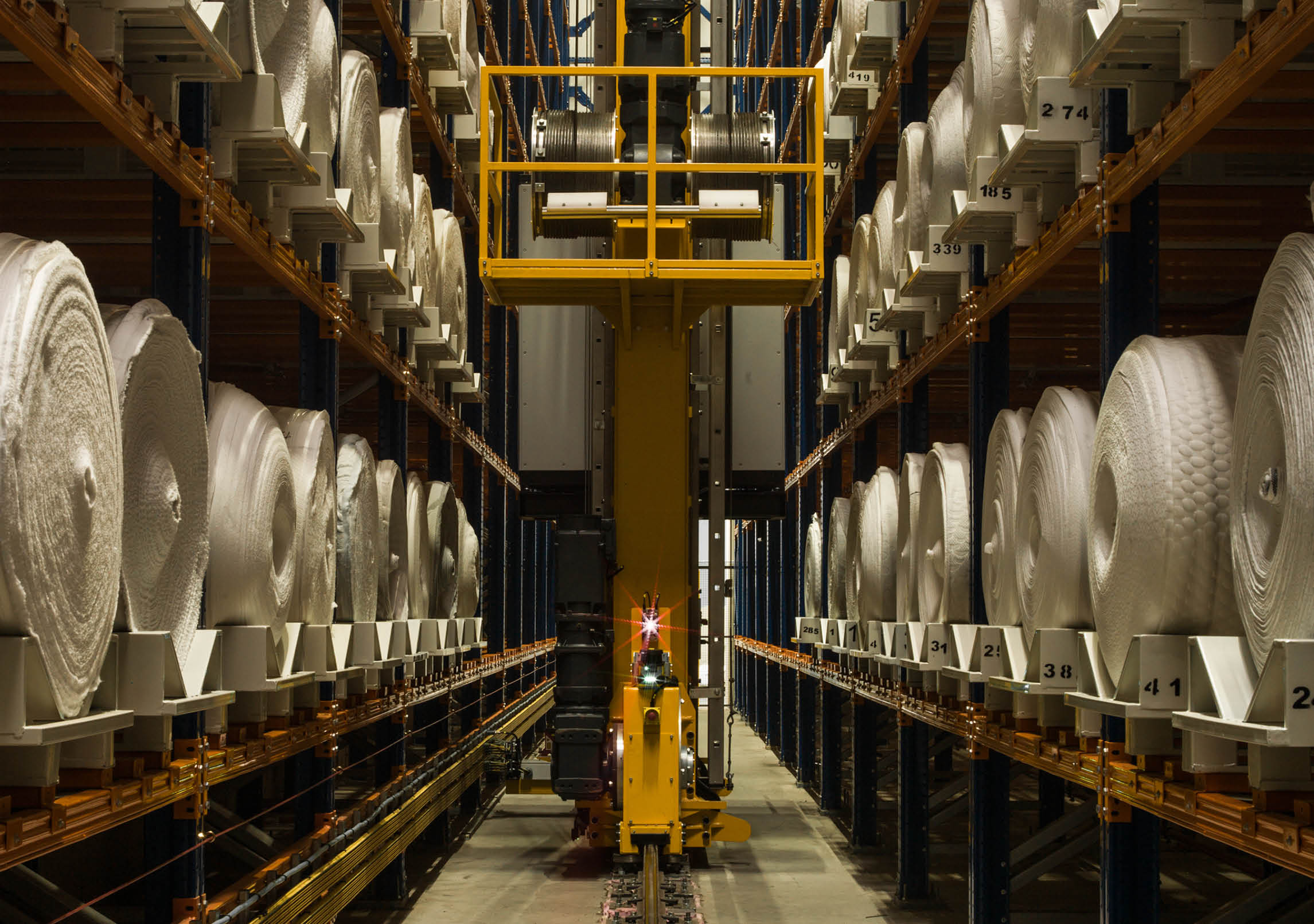
The company also emphasizes its use of natural fibers in ticking, even while acknowledging that there are trade-offs to consider when prioritizing sustainability. “The tension between natural-fiber preferences and functional performance is something everyone is working to navigate,” Franklin says, “balancing customer needs with what works for their brand and what message they want to present.”
Aydin describes Boyteks’ commitment to sustainability as a core principle—“beyond being merely a trend.” Internally, the company monitors its carbon and water footprint and works in accordance with ISO 14001 Environmental Management System and ISO 50001 Energy Management System certifications. The company also is working to increase its use of renewable energy.
While Aydin notes that its natural-fiber-based ticking, including the Nettle line, garners significant interest from customers, the company has several other ticking products meant to address just about every aspect of what it means to be sustainable. For example, its Enviro ticking is developed from recycled waste oils, R-Turn features faster biodegradability, and Repreve is being produced from recycled plastics.
Cleyman suggests that some of these advances may be ahead of the curve when it comes to customers’ priorities. “It’s a growing market for sure, but it’s still small,” he points out. “In the end, sustainability is on the lower rank of the decision-making for people buying a mattress. People are driven by quality perception, by brands they know are renowned for producing mattresses for a long time.”
Customers expect the design to reflect that quality, and then they weigh whether the price aligns with their perception of the final product. That’s how purchases are made, and at this point in time at least, sustainability, Cleyman says, “is not the main concern.”
Function: The new frontier
A trend that is perhaps growing faster than sustainability is the increasing desire for our beds—and ticking specifically—to do more than just deliver a good night’s rest. “We are seeing a substantial increase in interest regarding the functionality of the mattress fabric,” Cleyman says. “The biggest requested functionality is temperature control in the mattress.”
“Exceptional fabric design is only the beginning,” adds Creighton. “We enhance it with a performance-driven story that highlights features such as cooling innovation, sustainable materials, and engineered breathability to help set our customers up for success.”
A few years ago, Global Textile Alliance introduced the Nordic cooling yarn. “Because of the technology used, fabrics will warm up less easily and will cool down fast, even when covered with a fitted sheet,” Creighton says. “And since the cooling property is inherent to the fabric itself, it can be washed without losing its functionality.”
Boyteks also has its Cooler ticking fabric, which has a high temperature-flow capacity due to its thermal conductivity features and a high value of thermal absorptivity. And three years ago, Innofa introduced Sno, its triple-cooling technology, which “by a proprietary way of application and in combination with specific yarns and conductive technology, creates a significantly higher cooling effect,” Cleyman says.
Today, the Sno line of products accounts for 35% to 40% of Innofa’s production. “We also produce cooling accessories like pillows, sheets, and mattress protectors to provide a complete package,” Cleyman says, adding that the company is continuing to innovate. “We’re now working on a completely new patented [cooling] technology, which we hope to introduce at Interzum next year.”
Franklin agrees that cooling and temperature regulation continue to be important trends within the industry. But there is great variety in how companies are incorporating those functions. At Maes, she says, “We have high-percentage-wool fabrics, which are great at natural temperature regulation. We also do have some of the cooling technologies, either in the cool-to-the-touch yarn or the physical-cooling [phase change materials] finish.”
Going back to sustainability, Franklin says she believes many customers are interested in a “more natural cooling story.”
“By ’natural,’ ” she says, “I think most customers mean using a Tencel or a natural cellulosic fiber that has a cool-to-the-touch feel, rather than synthetic yarns.”
“Exceptional fabric design is only the beginning. We enhance it with a performance-driven story that highlights features such as cooling innovation, sustainable materials, and engineered breathability to help set our customers up for success.”
– Lindsay Creighton,
vice president of sales, GTA Textiles USA
The wellness promise
While it is one thing to engineer fabric for temperature control, a variety of wellness fabrics coming to market are offering much more, from improving blood circulation to reducing muscle aches and enhancing cell growth.
“I see the wellness component in the U.S. market as a niche,” Franklin says. “There are some successful brands using wellness and, if done well, it can create a strong marketing story. The main thing is to keep the message straightforward and valid, because that maintains the market integrity.”
To keep wellness claims valid, Franklin believes companies must be willing to substantiate—through science and research—the claims being made.
“The concentration of the active ingredients has to be high enough to create that functionality,” Cleyman adds. “It’s a difficult niche.”
That functionality is complicated by the fact that, once a mattress is sold, ticking manufacturers have no control over how many additional layers of material—sheets, mattress covers, blankets—may come between the wellness fabric and the sleeper, thereby weakening, if not negating, any potential benefits.
Still, the interest in this segment continues, with Boyteks promoting a number of wellness fabrics, including ChakraZen, intended to increase oxygen and nutrient transport to cells; Youthrest, which contains hyaluronic acid and collagen to improve skin’s moisture balance; Ozone Therapy, developed to reduce the effects of oxidative stress; and Synergy, designed to help restore energy lost during the day. Innofa also produces a wellness fabric called Far Infrared, designed to benefit blood circulation and muscle recovery.
One fabric, many stories
While the companies BedTimes spoke with agree on the key trends driving ticking today, they are addressing those trends in their own ways, serving different market segments with different priorities. Yet, as demonstrated at ISPA EXPO, all of them are working to address the supplier’s challenge: to deliver quality, performance, and appeal in a single fabric, for a product most buyers will cover with sheets and other accessories and never see again.
Through adaptation and innovation, the industry is continuing to find creative solutions to today’s—and tomorrow’s—retail reality.
The Total Package
Although mattress manufacturers and ticking suppliers have been working together in design development for a while now, the nature of those relationships has shifted over time.
“There has been a big change from when I started working in this industry,” says Camilla Franklin, vice president of sales at Maes Mattress Ticking. In the past, most customers simply would order what was offered, with very little customization. “That has completely flipped from 80/20, with 20% being customized, to being closer to 80% customized today. The fabrics’ performance requirements have increased, so that increases the development complexity.”
It is a shift from ticking as practical necessity to ticking as an integral contributor to a mattress’s overall performance.
This approach is exemplified in Boyteks’ manufacturing process, which unites ticking and mattress in a single building. “All of our knitted and woven mattress ticking production is carried out under one roof in our 97,425-square-meter integrated facility,” says Aydin Aydin, marketing and brand manager. “Sustainability, performance/functionality, and design elements are considered from a holistic perspective. This integrated production system ensures consistency while guaranteeing our high-quality approach across all processes.”
Modern FR Fabrics
Flame-retardants and fabric layers have been mattress features for more than 50 years. However, the nature of those solutions has changed over time. Moving away from once-popular FR chemical treatments, manufacturers have been increasingly exploring more sustainable options to pass the two key regulatory requirements: 16 CFR 1632 (resisting smoldering ignition, e.g., from a cigarette) and 16 CFR 1633 (resisting an open flame, e.g., fire).
Every manufacturer BedTimes spoke with is continuing to develop FR solutions, although some were unable to share proprietary details at this point.
However, Aydin Aydin, marketing and brand manager for Boyteks, reports rising interest in bio-based FR products, a range his company is exploring. “Our BioFR application has 100% bio-based properties,” he says. “In addition to FR solutions developed with natural and synthetic yarns, we offer various finishing alternatives suitable for different [FR] standards and technical requirements. By offering different FR barrier solutions in line with customer demands, we continuously maintain our innovative work in this field.”