New York state legislators worked late into the night at the end of the 2026 legislative session in early June, scrambling to handle lingering legislation on myriad topics. On the table was the possibility that the state would advance extended producer responsibility bills for packaging. The measures would place responsibility for handling packaging waste—such as the plastic protective sleeves that cover mattresses—onto brands and packaging companies.
The lobbying team for the International Sleep Products Association watched from the sidelines. Andy Hackman, principal lobbyist at Serlin Haley, one of ISPA’s lobbying firms, had ensured that legislators who opposed the proposals would be prepared for any debates that might arise. “The core arguments were that this is a punitive bill that is going to increase the cost of goods to consumers—increase the cost for any products that they buy,” Hackman says.
To his relief, the legislative session ended without EPR bills moving forward. For now, at least.
“That argument won the day,” Hackman says. “There were a number of fundamental flaws with the legislation. All of those culminated into the fact that the proposals would cost their constituents. That resonated with the legislators. That is what caused them to take a pause.”
As Hackman relaxed a bit after the victory, he emphasized what a pause means. The legislation will be revived next year, under a new sponsor and with new details.
A short history of EPR
EPR concepts for packaging have been around for decades, gaining traction first in Europe, Canada, and elsewhere as a way to divert packaging and other waste away from landfills so that it can be reused, repaired, or recycled. Product manufacturers are held responsible for their packaging waste and pay into systems to develop robust disposal systems. Under most plans, a producer responsibility organization builds and manages an EPR program and assesses fees based on formulas that account for the types and amounts of waste. For instance, easy-to-recycle materials with a high value, such as aluminum cans, would have a lower cost than hard-to-recycle materials, such as plastic films.
To ensure they had a voice at the table, advocates for businesses and industry—from brands to packaging companies—determined along the way that it would be best to work with states debating EPR programs rather than to simply oppose them. PROs, therefore, coordinate with companies, state regulators, and environmental stakeholders to build out and finance the recycling and waste programs that would meet EPR goals set by statutes and regulations.
The seven states to pass legislation so far are California, Colorado, Maine, Maryland, Minnesota, Oregon, and Washington. The PRO in all of them except Maine is Circular Action Alliance. A nonprofit founded in 2022, CAA is “guided by producers representing the food, beverage, consumer goods, restaurant, and retail industries,” according to its website. Instead of a PRO, Maine uses a similar concept called a stewardship organization and has yet to pick one to run its program.
One problem has been that each state adopts its own regulations, requiring companies to learn and comply with all the different details. “They are not 100% consistent,” Hackman points out. “They all have their own little quirks and unique requirements.”
For example, Colorado’s EPR for packaging law handles packaging for businesses differently than it does for residents, while Oregon’s law handles residential and commercial packaging similarly, he says.
The most recent EPR adopters—Maryland, Minnesota, and Washington—attempted to harmonize their programs, although they have unique requirements, too, Hackman adds.
For national and international companies, compliance can be unwieldy because they sell into multiple countries and every state. And smaller companies often lack the resources to navigate the complexities of the various rules. Indeed, a cottage industry has sprouted in recent years to help guide companies through the regulatory quagmire.
“The packaging regulations are driving everybody up the wall. Seven states have laws, and none of them are the same,” says ISPA President Alison Keane. “It is the wild west out there. Like every other producer, mattress companies have to deal with it. We don’t produce our own packaging—the flexible packaging and the cardboard manufacturers produce it—but we still have to navigate all this.”
Individual companies are often reluctant to comment about the various EPR proposals. Instead, they rely on trade associations and industry groups, such as ISPA, the Flexible Packaging Association, and AMERIPEN—the American Institute for Packaging and the Environment—to speak for them. Those groups, as well as various recycling and waste organizations, monitor legislative initiatives for their members and advocate for sensible and fair EPR programs to counter a strong environmental lobby. (Hackman also serves as a lobbyist for FPA and AMERIPEN).
Keane mentions how small producers of mattress packaging have contacted her because they are nervous about falling into noncompliance with state regulators. She often points people to CAA. The PRO provides detailed information about each state on its website, circularactionalliance.org. The site provides important deadlines and step-by-step instructions on what companies need to do. CAA holds periodic online educational webinars, and past webinars are available for viewing.
Because CAA operates as a PRO in six of the seven EPR states, that stability has helped companies navigate the complex systems. “CAA is certainly working toward consistency from a data, registration, and compliance perspective, yet there still are differences in the state laws,” Hackman says.
New York’s proposal
Stakeholders nationwide were watching the situation play out in Albany because the New York proposal veered substantially from some of the core EPR concepts that have been implemented in other states. For instance, the legislation called for waste producers to fund landfilling operations in addition to recycling systems.
“This bill was very different than any other state, and the landfilling requirement was part of the significant additional costs to consumers,” Hackman says. “They also had a 30% source-reduction mandate, so companies would have had to eliminate 30% of their packaging over 12 years, and that was significant, too.”
After years of intense EPR legislation in various states, the New York proposal was the only significant EPR plan in 2026. However, the fate of the proposal was expected to affect other states, particularly in the Northeast, where policymakers are still determining how they will proceed.
“New York not taking action this year likely will have a chilling effect on other Eastern and Northeastern states, such as Connecticut, New Jersey, Massachusetts, and Rhode Island,” Hackman says, adding that some states will continue to study EPR and likely move forward eventually. “Rhode Island, for example, is doing a needs assessment to study what its recycling system might look like.”
Debates continue about ways to standardize EPR regulations, and some ongoing discussions on the federal level would create uniform definitions for recycling terms. National standardization of EPR programs is unlikely anytime soon, partly because recycling and waste management remain local and state issues. Congress is not in a hurry to intervene, Hackman says: “That is way off in the distance.”
However, if federal courts eventually rule that EPR laws violate the U.S. Constitution in some way, Hackman quickly adds, Congress might be more apt to weigh in sooner.
“The only way I could see some sort of a reset that might involve federal activity is if lawsuits determine that elements of the EPR laws are unconstitutional,” he says. “I could see the U.S. Department of Justice getting involved under this administration, perhaps, so there is some potential dynamic there. Otherwise, Congress is a long way from taking on this issue and regulating it uniformly across the U.S.”
Key lawsuits
ISPA is not the only entity paying attention. Numerous industries are watching court challenges to the law in Oregon, which was the first state to fully implement an EPR for packaging program.
Earlier this year, the National Association of Wholesaler-Distributors filed suit in U.S. District Court in Oregon challenging that state’s Recycling Modernization Act. Some of the issues NAW raised involve constitutional questions, such as whether the act violates the dormant commerce clause, which limits state and local laws from unduly creating a burden on interstate commerce. NAW also questions whether PROs should be allowed to oversee EPR programs as they currently operate.
With court hearings being held this year, various appeals might keep litigation in play for a long time, say Hackman and Keane.
Meanwhile, various entities are monitoring EPR for packaging lawsuits because similar programs have existed for years for other industries, such as companies that produce paint and mattresses. The EPR program for mattresses—overseen by the Mattress Recycling Council, a nonprofit organization created by ISPA—has been operating in several states since 2015 (see “More on Mattress Recycling and Packaging,” below).
“If the courts find that this concept of PROs violates the Constitution through burdens to interstate commerce or due process claims, that would be a pretty significant finding for more than just packaging,” Hackman says.
EPR for packaging has had a high profile in recent years because packaging touches nearly every industry, unlike more targeted EPR programs, Hackman also points out. “Packaging cuts across a broader swath because pretty much anything you buy is going to come with some level of packaging,” he says.
In the meantime, environmentalist groups, including the Natural Resources Defense Council and Californians Against Waste, filed a separate case in California, asserting that the state’s EPR law doesn’t go far enough. More lawsuits and court filings are expected, including ones representing businesses and industry challenging the environmentalists’ lawsuits in California, Hackman and Keane say.
CAA notes that it is not a party to the lawsuit filed by the NAW in Oregon.
“Legal challenges can arise in connection with significant policy change. The underlying statutory requirements in each state remain in force unless changed by a court or legislature, and CAA continues to operate to facilitate producers’ compliance within each state’s requirements,” Larine Urbina, senior vice president of communications at CAA, said in a written response to questions. “We do not speculate on timelines or outcomes for any active litigation. Any impacts would depend on the scope of a court’s ruling, and regulatory authorities would provide direction as appropriate.”
Moving ahead
Observers, including CAA, caution companies not to wait to see what happens in the courts before they comply with a state’s requirements.
“In Colorado, as well as Oregon, if people have not figured out how they are affected—and that includes mattress companies—they really need to get on it ASAP,” Hackman adds.
In Oregon, the court initially granted an injunction on compliance with its law that only applies to companies that are members of NAW. All other companies must comply and work with CAA to ensure they are meeting deadlines, Hackman says. Since June, Colorado has been fully implementing its EPR packaging program, having collected fees from packaging producers and assessing fines for companies that have failed to comply.
“Oregon and Colorado are already in active program operation, with producer registration, reporting and program participation requirements currently in effect,” Urbina said. “Producers who have not yet registered are encouraged to do so as soon as possible to ensure they are meeting their obligations under state law.”
California’s EPR program regulations were finalized in May, and the full program launches on Jan. 1, 2027, with various deadlines that companies must meet in play.
California’s program has expansive obligations, Urbina pointed out. “Producers should not wait as registration and reporting are already underway,” Urbina advised, adding that CAA will support producers through the process.
Companies must stay informed and engaged, even though it seems daunting, Keane says. “This is a heavy compliance burden. There are so many tendrils out there to follow—from the EPR laws to the court cases,” she says. “There is just way too much going on, and there is way too much uncertainty. Like I said, it is the wild west.”
More on Mattress Recycling and Packaging
People in the mattress industry will be familiar with the extended producer responsibility concept because of the Mattress Recycling Council that formed in 2015, says Alison Keane, president of ISPA and MRC.
The consumer-facing program, known as “Bye Bye Mattress®,” operates in California, Connecticut, Oregon, and Rhode Island. Like EPR for packaging programs, the mattress initiative is funded by a recycling fee collected when consumers buy a mattress or box spring.
One big difference—and a reason the mattress industry needs to pay attention to EPR for packaging programs—is that mattresses are not recycled for years, if not decades, after a purchase. Under the current mattress programs, packaging materials would have been disposed of at the time of delivery to a household, Keane points out.
The flexible plastic sleeves placed over the mattress, plus the cardboard shipping containers, are examples of what would fall under new EPR packaging programs, she adds. “We do EPR for mattresses at the end of life with the consumer,” Keane explains. “Now we are going to be liable as well for packaging—like most products and product manufacturers.”
Cardboard is relatively easy to recycle through most standard curbside residential collection programs. That and other easy-to-recycle materials—such as cans, bottles, and some plastics—go from a household to a materials recovery facility, or MRF, where the materials are separated mechanically and recycled. Wood and metal, such as the slats and springs in a mattress or box spring, are also relatively easy to handle, Keane says.
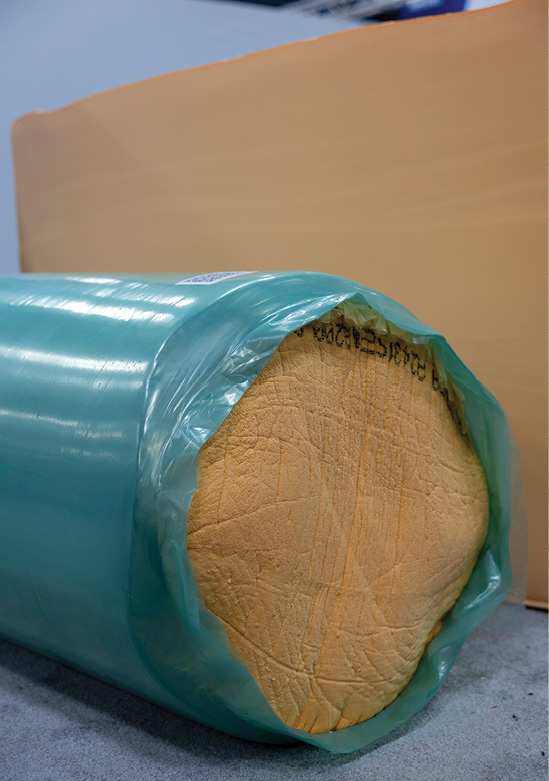
However, the plastic sleeves that protect a mattress are flexible plastic films that are considered “hard to recycle” and can gum up MRF sorting machines, says Keane, who is a former president and CEO of the Flexible Packaging Association based in Annapolis, Maryland.
As states move to adopt EPR for packaging programs, the producers of flexible films could face closer scrutiny from policymakers and opponents to flexible films and other plastics. A lawsuit in California filed by environmentalists, for example, contends that California’s EPR law, known as SB54, doesn’t go far enough and should ban so-called advanced or chemical recycling that would help keep flexible packaging and films from entering landfills. (New York’s proposal that failed to pass in June also would have banned advanced recycling).
Supporters of advanced recycling argue that it is a way to transform hard-to-recycle materials by breaking them down into new materials, such as plastic pellets that can be used to create new products. Detractors of advanced recycling often oppose all forms of plastic and argue that advanced recycling encourages the continued use of plastics.
ISPA supports the advanced recycling concept, partly because it is a way to divert foam from landfills. “We definitely want to see advanced recycling, and not necessarily because of the packaging issue but because of the foam,” Keane says.
Traditionally, mattress foam can be recycled and eventually go into other products, such as carpet pads. With the decline in consumer demand for carpeting, more end markets are needed, which is where advanced recycling would be useful, she explains.
“You can recycle about 75% of a mattress,” Keane points out. “The foam still goes into carpet padding. It’s just that people are not installing as many carpets as they once did. We are constantly trying to find new value-added products where this old foam can be used.”
Advanced recycling would help with mattress covers, too, she adds. The quilt material on the top of a mattress is difficult to recycle, so it ends up in landfills. Although several states have been looking into EPR for textiles, a successful textile program likely would need advanced recycling. “If you do not have advanced recycling, I don’t know what they are going to do with the textiles,” Keane says. “When you think about apparel, it is cotton, it is polyester, it is synthetics. It is a whole bunch of things mixed together. It is very much like the top of beds.
“There is not a lot you can do with it through mechanical recycling,” she continues. “Without advanced recycling, they are not going to meet their recycling targets.”
These EPR issues are important because policymakers’ decisions could undermine companies’ bottom lines, Keane says.
“The way these EPR laws for packaging are structured, you pay more for the packaging that isn’t easily recyclable,” she notes. “It is definitely going to add costs. There is no question about it.”